Could Your Global Business Create a Permanent Establishment and Trigger Unexpected Tax Liabilities?

When Business Without Borders Creates Tax Exposure In today’s interconnected business environment, companies can access international markets without establishing a physical office in every country where they operate. A foreign enterprise may serve Indian customers remotely, deploy employees to India, engage local representatives, or provide consulting and technical services across borders. However, an important question arises: Can a company become liable to pay tax in…


Buying Property from a Non-Resident Just Got Easier for Individual Buyers

Purchasing property from a non-resident seller has traditionally involved additional tax at source (TDS) compliance for resident individual buyers and Hindu Undivided Family (HUFs), including the requirement to obtain a Tax Deduction and Collection Account Number (TAN). A resident individual or HUF purchasing immovable property from a non-resident seller was previously required to obtain a Tax Deduction and Collection Account Number (TAN), deduct the applicable…

When Algorithms Question Your Tax Returns

Tax disputes are changing. The next question from the tax authorities may be generated by data before it is raised by a human. Tax administration is no longer limited to what a taxpayer reports in its income-tax return. Today, information flows across multiple systems, including GST returns, TDS statements, the Annual Information Statement (AIS), financial transactions, foreign remittances, banking records and information reported by third…

FAST-DS: A Window of Opportunity to Disclose Undeclared Foreign Assets and Income

As announced in the Union Budget 2026, CBDT has notified the Foreign Assets of Small Taxpayers – Disclosure Scheme (FAST – DS), effective from 16th August 2026 to 31st December 2026. FAQs have also been issued to provide further clarity on the scheme. FAST-DS presents a valuable opportunity for small taxpayers to voluntarily disclose foreign assets or income that may have been inadvertently omitted from…

Artificial Intelligence in Tax Practice From Compliance to Strategic Advisory

For decades, tax practice followed a predictable rhythm: gather documents, enter numbers, cross-check them against the previous year’s return, research grey areas, and hope filing season ends before burnout does. That rhythm is now changing, not because the tax code has become simpler, but because artificial intelligence is quietly transforming how the work gets done. This transformation is not merely about automation; it is about…

Updated Returns and the Latest Amendments

Before the insertion of section 139(8A), the Income-tax Act did not provide taxpayers with any mechanism to voluntarily disclose additional income once the prescribed time limit for filing a revised return had expired. The absence of such a remedial provision discouraged voluntary corrections and limited taxpayers’ ability to rectify genuine mistakes. Recognizing this practical challenge, the Government introduced a significant compliance-oriented reform through the Finance…

India Strengthens Its Global Debt Market Position Through Sovereign Bond Tax Relief

In a strategic move to strengthen its position in global debt markets and enhance its appeal to international investors, the Government of India has promulgated the Income-tax (Amendment) Ordinance, 2026. The Ordinance exempts specified foreign investors from tax on interest income and capital gains arising from investments in Indian Government Securities, reinforcing India’s commitment to creating an investor-friendly and globally competitive financial ecosystem. While the…

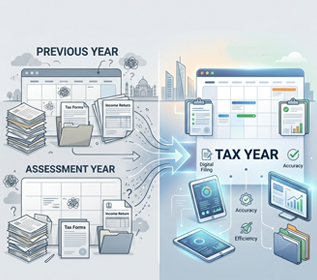
Transitioning from Previous Year and Assessment Year to Tax Year

The dual system operated under the provisions of the Income Tax Act, 1961. Section 3 of the Act defined the “previous year” as the financial year immediately preceding the assessment year or, in certain cases, the period commencing from the start of a business until the end of that financial year. Section 4, being the charging provision, stipulated that income tax would be levied on…

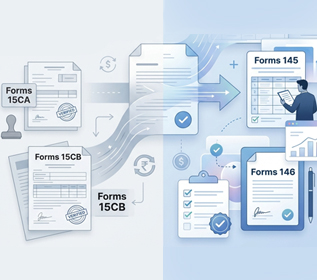
Understanding Forms 145 & 146: From Familiar to Future-Ready

The evolution of India’s tax compliance framework under the Income-tax Act, 2025 and the Income-tax Rules, 2026 signals a decisive move toward greater digitization, standardization, and strengthened regulatory oversight. Traditionally, Forms 15CA and 15CB have played a pivotal role in governing foreign remittance compliance where Form 15CA served as a declaration by the remitter, and Form 15CB provided a Chartered Accountant’s certification on the taxability…

India’s New Tax Era Under the Income Tax Act, 2025

India is entering a transformative phase in its taxation journey, with the Income Tax Act, 2025 ushering in a more modern and streamlined regulatory framework. In an increasingly complex economic environment, tax systems must evolve not only to keep pace with change but to actively enable progress. India’s direct tax framework, shaped over decades through incremental amendments, has long required structural simplification to remain aligned…