
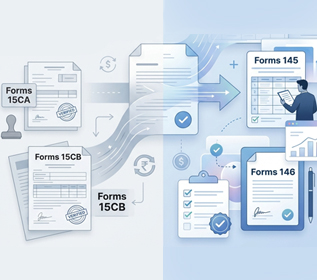
The evolution of India’s tax compliance framework under the Income-tax Act, 2025 and the Income-tax Rules, 2026 signals a decisive move toward greater digitization, standardization, and strengthened regulatory oversight. Traditionally, Forms 15CA and 15CB have played a pivotal role in governing foreign remittance compliance where Form 15CA served as a declaration by the remitter, and Form 15CB provided a Chartered Accountant’s certification on the taxability of such transactions.
With the introduction of the new framework, the existing forms have been replaced as follows:
- Form 15CA → Form 145 (Declaration by remitter)
- Form 15CB → Form 146 (Certificate by Chartered Accountant)
While the fundamental principles of compliance remain unchanged, this restructuring is aimed at creating a more uniform form-numbering system and enhancing the overall clarity and efficiency of the reporting framework.
Understanding Form 145 and Its Applicability in Foreign Remittances
Form 145 is a declaration required to be furnished by the remitter at the time of making a payment to a non-resident or a foreign company. It continues to serve as a key compliance tool for tracking outbound remittances and ensuring that applicable tax obligations are duly evaluated before the transaction is executed.
The revised format mandates comprehensive disclosures, including details of the remitter and remittee, the nature and purpose of the remittance, relevant statutory provisions, and the taxability status of the payment.
Similar to the earlier Form 15CA, Form No. 145 is divided into four parts, each applicable based on the nature and value of the remittance:
- Part A: Applicable where the remittance is chargeable to tax and does not exceed ₹ 5 lakh during the financial year
- Part B: Applicable where the remittance is chargeable to tax and exceeds ₹ 5 lakh during the financial year, and a certificate u/s 395(1) of the Income-tax Act, 2025 has been obtained from the Assessing Officer
- Part C: Applicable where the remittance is chargeable to tax and exceeds ₹ 5 lakh during the financial year, and a certificate in Form No. 146 has been obtained from a Chartered Accountant
- Part D: Applicable where the remittance is not chargeable to tax.
Understanding Form 146 and the Scope of Chartered Accountant Certification
Form 146 replaces Form 15CB and is issued by a Chartered Accountant to certify the accuracy and appropriateness of the tax treatment applied to foreign remittances.
The form requires a comprehensive evaluation of:
- Nature and characterization of income
- Applicability of relevant Income-tax provisions
- Eligibility and interpretation of DTAA benefits
- Accurate computation and applicability of TDS
Form No.146 may be withdrawn within 7 days from the date of submission. However, once it has been “consumed” by the taxpayer while filing Form No.145 (Part C), it cannot be withdrawn independently by the Chartered Accountant unless the corresponding Form No. 145 is first withdrawn by the taxpayer.
The revised format calls for a higher degree of precision and reinforces the responsibility of professionals to ensure that certifications are robust, well-documented, and technically sound.
Understanding the Shift: A Comparative View of the Two Frameworks
The transition from Forms 15CA/15CB to Forms 145/146 brings several practical and compliance-related changes, even though the underlying legal framework remains unchanged.
| Particulars | Old Forms (15CA / 15CB) | New Forms (145 / 146) |
| Form Numbering | Unstructured | Systematic and aligned with revised rules |
| Tax Identification Number (TIN) of Non-Resident | Not consistently required in all cases | Mandatory disclosure required |
| Form 41 (erstwhile Form 10F) | Required only where TRC was incomplete | Mandatory along with TRC in all applicable cases |
| DTAA Reporting | Basic disclosure | Enhanced reporting with clearer bifurcation and detailed disclosures |
| UDIN (Unique Document Identification Number) | Not Captured | Captured in Part C of Form 145, enabling ICAI API-based real-time verification and improving authenticity |
| FRN and PAN of Accountant | Not captured | Mandatory fields introduced for verification with the departmental database |
The introduction of Forms 145 and 146 reflects a measured and forward-looking evolution in India’s approach to regulating cross-border payments. While the foundational compliance framework remains unchanged, enhanced reporting requirements, mandatory disclosures such as TIN, and stronger documentation through TRC and Form 10F point clearly toward greater transparency and accountability. For Chartered Accountants, this shift underscores the need for deeper technical evaluation, careful interpretation of provisions, and well-supported documentation. The revised forms go beyond a procedural update, signalling a move toward a more disciplined, data-driven, and globally aligned compliance environment. In this evolving landscape, the role of professionals becomes increasingly critical. Expert guidance not only ensures accuracy and compliance but also helps navigate complexities, mitigate risks, and bring confidence to cross-border transactions.