
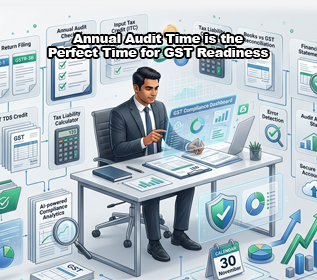
With the financial year now concluded and the annual audit season underway, businesses are primarily focused on finalising their financial statements and completing the statutory audit. Alongside the financial audit, this is also the ideal time to undertake a comprehensive review of GST compliance to ensure that all GST-related matters pertaining to the previous financial year are appropriately addressed before the statutory deadlines expire.
The period up to 30th November following the end of the financial year provides taxpayers with a valuable opportunity to rectify omissions, claim eligible Input Tax Credit (ITC), and discharge any additional GST liabilities relating to the previous financial year. A timely GST review not only facilitates a smoother statutory audit but also helps minimise the risk of future disputes during departmental scrutiny or GST audits.
1. Review and Update GST Returns Before 30th November
The GST law permits taxpayers to make certain amendments relating to the previous financial year up to 30th November of the following financial year, subject to the applicable provisions.
Businesses should review whether:
- Any sales invoices relating to the previous financial year were inadvertently omitted from GSTR-1 and need to be reported.
- Debit Notes or Credit Notes arising from year-end adjustments, audit observations, pricing revisions, discounts, or other accounting adjustments have been appropriately reflected in GSTR-1.
- Any corrections required in GST returns are completed within the prescribed timeline to avoid permanent loss of opportunity to make such amendments.
2. Review Input Tax Credit (ITC)
Input Tax Credit (ITC) represents a significant asset for every business and therefore warrants careful verification during the annual closing process.
The following areas should be reviewed:
- Identify eligible ITC that has not been reflected in GSTR-2B.
- Follow up with vendors and suppliers who have not reported tax invoices in their GSTR-1, resulting in non-availability of eligible credit.
- Ensure that ITC relating to GST paid under the Reverse Charge Mechanism (RCM) has been appropriately claimed after payment of the tax.
- Reconcile ITC recorded in the books of accounts with the Electronic Credit Ledger available on the GST portal.
A timely review helps prevent the loss of eligible tax credits and strengthens overall GST compliance.
3. Claim GST TDS Credit
Businesses supplying goods or services to Government Departments, Government Authorities, Public Sector Undertakings, and other notified entities should verify whether GST TDS has been deducted from their invoices.
The following checks are recommended:
- Identify GST TDS deducted by customers.
- Reconcile GST TDS reflected on the GST portal with accounting records.
- Accept the GST TDS on the GST portal so that the corresponding amount is credited to the Electronic Cash Ledger.
- Utilise the available balance to discharge future GST liabilities.
Failure to claim GST TDS on time may result in an unnecessary blockage of working capital.
4. Discharge Additional GST Liability, if Any
The annual audit often uncovers transactions that require the payment of additional GST.
Businesses should evaluate whether there is any:
- Additional GST liability arising from audit adjustments or an increase in revenue recognised in the financial statements.
- GST liability under the Reverse Charge Mechanism (RCM) that may have been overlooked during the year.
- Interest payable on account of delayed payment of GST.
Discharging such liabilities voluntarily before they are detected by the tax authorities can significantly reduce future compliance risks and potential litigation.
5. Perform Comprehensive GST Reconciliations
Accurate reconciliations form the foundation of effective GST compliance and reliable financial reporting.
Key reconciliations include:
- Turnover as per the books of accounts versus turnover reported in GST returns.
- Input Tax Credit as per the books of accounts versus the Electronic Credit Ledger available on the GST portal.
- GST payments as per books of accounts versus the balance available in the Electronic Cash Ledger.
Reconciling these balances helps identify omissions, duplicate entries, reporting errors, and unmatched transactions before the completion of the statutory audit.
Benefits of Being GST Ready
A well-planned GST review before the completion of the annual audit offers several important benefits:
- Enables businesses to provide accurate explanations and supporting documentation to statutory auditors.
- Ensures correct disclosure of GST liabilities and Input Tax Credit in the financial statements.
- Simplifies the preparation and filing of the Annual GST Returns (GSTR-9) and GST Reconciliation Statement (GSTR-9C), wherever applicable.
- Creates reliable documentation that proves valuable during future GST scrutiny, departmental audits, or investigations.
- Minimises interest costs, penalties, and litigation arising from avoidable compliance gaps.
Conclusion
The annual audit presents an excellent opportunity for businesses to evaluate their GST compliance and address any gaps before the statutory timelines expire. A proactive review helps identify eligible tax credits; report pending transactions, discharge any additional GST liabilities, and ensure that GST records are fully aligned with the books of accounts.
As the window for making corrections relating to the previous financial year remains open only until 30th November, businesses should complete their GST review well in advance. Timely action not only facilitates a smooth statutory audit and accurate financial reporting but also strengthens overall GST compliance and significantly mitigates the risk of disputes during future GST assessments, scrutiny proceedings, or departmental audits. Engaging experienced tax professionals during this review can help businesses identify compliance gaps, optimise eligible tax benefits, and ensure that GST obligations are addressed accurately and in accordance with the applicable legal provisions.