
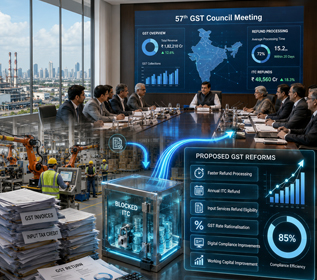
With GST 2.0’s rate rationalisation largely complete, the GST Council is now turning its attention to a far more complex, but equally significant issue that has quietly strained the finances of businesses across India — the accumulation of Input Tax Credit (ITC) under the Inverted Duty Structure (IDS).
As the Council prepares for its 57th meeting, expected in late July or August, government sources indicate that the focus is shifting from tax rate simplification to long-awaited process reforms. Among the most anticipated items on the agenda is addressing the persistent challenges arising from the inverted duty structure.
For manufacturers and processors burdened with blocked ITC and stretched working capital, this meeting could prove to be one of the most consequential in recent years.
What’s on the Table: The Reform Agenda
The upcoming Council meeting is expected to take forward a broad process-reform agenda that builds on the groundwork laid during previous sessions. Officials have indicated that the September 2025 meeting approved a simplified GST registration scheme to make compliance easier for the vast majority of new registrants. A simplified registration framework for small suppliers selling through e-commerce operators was also discussed and expected to return to the Council for formal approval.
Beyond registration reforms, the Council is expected to deliberate on several measures designed to strengthen GST administration and improve ease of doing business, including:
- Streamlining and introducing time-bound processing of GST refunds.
- Reducing litigation through standardised notices and wider use of technology.
- Reforming the GST Appellate Tribunal framework.
- Better synchronisation between GST returns, the Invoice Management System (IMS), and e-way bill data to minimize reconciliation challenges.
- Operationalising Section 11A of the CGST Act, which empowers the government to waive past tax liabilities where non-payment resulted from a widely accepted trade practice — a provision that has gained greater relevance following disputes such as the Gameskraft online gaming matter.
- Most importantly, addressing the Inverted Duty Structure (IDS) across key sectors.
Understanding the Inverted Duty Structure
An Inverted Duty Structure arises when the GST rate applicable to inputs — such as raw materials, input services, logistics, technology, or capital goods — is higher than the GST rate on the finished product. Simply put, businesses pay more GST while purchasing inputs than they recover when selling the final output.
The consequence is a continuous accumulation of unutilised ITC. Since the credit generated exceeds the output tax liability, businesses are unable to fully utilise it, leaving substantial amounts locked within the GST system. In effect, working capital that rightfully belongs to businesses remains tied up in tax credits instead of being available for business operations.
Industries particularly affected by this issue include pharmaceuticals, textiles, footwear, food processing, paper, and electric vehicles, where GST paid on raw materials, services, logistics, and capital investments often exceeds the tax collected on outward supplies.
GST 2.0 Brought Relief — But Not a Complete Solution
The recent GST 2.0 rate rationalisation offered much-needed relief by reducing certain rate disparities and simplifying the overall tax structure. While these changes have helped narrow some instances of inversion, they have not resolved the underlying issue. In many cases, rate rationalisation merely reduces the pace at which ITC accumulates, it does not eliminate the accumulation itself.
Recognising the liquidity concerns faced by businesses, the Council, in its previous meeting, approved a system-driven mechanism allowing provisional refunds of up to 90% of eligible inverted duty structure claims. This represents a significant improvement in the speed of refund processing and provides immediate cash flow support to affected manufacturers. However, while the mechanism accelerates refunds, it does not expand what qualifies for refund. That remains the larger challenge.
The Real Bottleneck: Input Services Continue to Remain Outside the Refund Net
This is where industry concerns are most pronounced. Under the existing refund provision for the Inverted Duty Structure, only accumulated ITC relating to inputs (goods) qualifies for refund. Credit accumulated on input services remains ineligible. For most manufacturing and processing businesses, however, a significant portion of the inversion arises from services such as:
- Logistics and transportation
- Warehousing
- Job work
- Technical and consultancy services
- Equipment rentals
- Other business support services that typically attract GST at 18%
These services often bear a much higher GST rate than the finished products sold by businesses, resulting in substantial credit accumulation that cannot be claimed. This distinction between goods and services was never intended to become a permanent feature of the GST framework. Rather, it stems largely from the manner in which the original refund formula was drafted. Consequently, even with the recently introduced 90% provisional refund mechanism, a sizeable portion of legitimate tax credit remains permanently blocked because only eligible credit can be refunded in the first place.
What Industry Expects from the 57th GST Council Meeting
As the Council prepared to meet, industry stakeholders are broadly seeking four key reforms:
- Extend refund eligibility to ITC on input services under the Inverted Duty Structure by removing the distinction between goods and services, thereby ensuring that genuine service-related credits are no longer permanently blocked.
- Allow annual refunds of residual unutilised ITC, ensuring that legitimate cycle do not remain locked indefinitely even after the provisional refund cycle.
- Undertake targeted rate rationalisation in strategic manufacturing sectors to eliminate inversion at its source rather than merely refunding its consequences.
- Introduce faster, standardised, and technology-driven refund processing with clearly defined timeliness to reduce uncertainty, delays, and litigation.
As one tax expert aptly observed, the continued blockage of legitimate tax credits effectively converts GST from a consumption-based tax into a business cost, undermining its fundamental objective of functioning as a seamless value-added tax. That observation captures precisely why industry views this issue as far more than a technical refinement.
Why This Matters for Manufacturers and Processors
For capital-intensive and service-driven manufacturing businesses, blocked ITC is not merely a compliance issue — it has a direct financial impact. It results in:
- Higher production costs, as unrefunded input tax effectively becomes part of the cost base instead of remaining a pass-through credit.
- Increased pressure on working capital, particularly for MSMEs and mid-sized manufacturers with limited financial flexibility.
- Reduced competitiveness against imports and businesses operating in sectors where duty inversion does not exist.
- Hesitation in making fresh investments, as GST paid on capital goods may also remain trapped under the same inverted structure.
At a time when India is actively promoting domestic manufacturing and positioning itself as a global manufacturing hub, the continued blockage of legitimate tax credit runs counter to these policy objectives. This is expected to be one of the strongest arguments advanced by industry bodies before the GST Council.
The Bottom Line
The 57th GST Council meeting comes at a stage where many of the easier reforms such as rate rationalisation and slab simplification have already been addressed. The next phase of GST reforms is more structural and arguably more important, ensuring that the refund framework functions as efficiently as the tax system itself. For manufacturers and processors, the single most meaningful reform would be extending refund eligibility to ITC accumulated on input services and finally removing the long-standing distinction between goods and services under the Inverted Duty Structure. Until that happens, GST 2.0’s rate rationalisation will continue to fall short of its full potential, leaving businesses with tax credits they have legitimately earned but still cannot utilise. In this evolving regulatory landscape, businesses should proactively review their GST positions, identify eligible refund opportunities, and stay prepared for policy changes. Seeking timely guidance from experienced Chartered Accountants can help organisations navigate complex GST provisions, optimise ITC claims, strengthen compliance, and ensure they are well-positioned to benefit from any reforms introduced by the GST Council.