
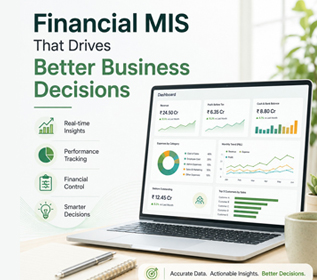
Every business generates financial data, but not every business transforms that data into meaningful business intelligence. While many organizations prepare financial statements as part of their statutory obligations, far fewer develop meaningful Financial MIS reports. The difference often determines how quickly management can identify challenges, capitalize on opportunities, and make informed decisions.
In today’s fast-paced business environment, organizations generate vast amounts of financial data every day. However, data alone does not create value. The real value lies in converting that information into meaningful insights that help leadership teams understand business performance, evaluate risks, and plan future actions. This is precisely where a well-designed Financial Management Information System (MIS) becomes indispensable, turning financial information into a powerful decision-making asset.
A Financial MIS is much more than a reporting exercise. It serves as a strategic management tool that enables decision-makers to move beyond historical accounting records and gain a comprehensive understanding of the business. By providing a structured view of financial performance, operational efficiency, cash flow position, and key business drivers, it empowers management to make timely, informed, and confident decisions.
Why Financial MIS Matters
One of the biggest challenges organizations faces is obtaining a complete and timely picture of their business performance. Financial statements prepared solely for statutory or compliance purposes often do not provide the depth of analysis required for day-to-day management. A Financial MIS bridges this gap by presenting financial information in a manner that is relevant, timely, and actionable.
With the right MIS in place, management can determine whether the business is performing as planned, where deviations are occurring, and what corrective actions may be required. It enables leadership teams to monitor profitability, evaluate operational performance, manage working capital, and assess liquidity. More importantly, it helps answer critical business questions such as:
Why are margins declining despite revenue growth? Why has working capital increased? Why is cash generation lower than expected? Which business segments are outperforming and which require intervention?
By answering these questions with clarity and precision, Financial MIS transforms the finance function from a record-keeping role into a strategic partner that supports sustainable business growth.
What Should an Effective Financial MIS Include?
An effective Financial MIS should present a comprehensive financial and operational overview of the organization. At its core are the three primary financial statements—the Profit & Loss Statement, Balance Sheet, and Cash Flow Statement, which together provide the foundation for meaningful financial analysis.
The Profit & Loss Statement provides insights into revenue trends, cost structures, operating profitability, and overall financial performance. It enables management to assess whether business growth is translating into improved profitability while identifying areas where costs may be rising disproportionately.
The Balance Sheet offers a snapshot of the organization’s financial position at a given point in time. It highlights the strength of the asset base, working capital efficiency, debt levels, liquidity position, and overall financial stability. A strong balance sheet often reflects the long-term resilience and financial health of the business, enabling management to plan future growth with confidence.
The Cash Flow Statement is equally critical because profitability and cash generation do not always move together. Businesses can report healthy profits while simultaneously facing cash flow constraints. Therefore, monitoring operating cash flows, investment activities, and financing movements is essential for maintaining financial discipline and ensuring that liquidity supports business operations.
Beyond these core financial statements, an effective MIS should include supporting schedules and annexures that provide deeper insights into key financial drivers. These may include receivable ageing reports, payable ageing analysis, inventory movement schedules, fixed asset summaries, borrowing details, project-wise profitability reports, and departmental performance analyses. Such detailed schedules help management move beyond high-level numbers and understand the operational factors driving overall business performance.
The Importance of Variance Analysis and Management Commentary
The true strength of a Financial MIS lies not merely in presenting numbers but in explaining what those numbers actually mean. Simply reporting financial performance is rarely enough to support effective decision-making.
A well-designed MIS should compare actual results against budgets, forecasts, previous periods, and historical benchmarks. Variance analysis highlights areas where performance differs from expectations and enables management to focus attention on matters that require corrective action or strategic review.
However, identifying a variance is only the first step. Understanding the reasons behind that variance is what creates genuine value. For this reason, management commentary is an indispensable component of every meaningful MIS report.
For example, if revenue has increased by 15% compared to the previous year, management should understand whether the growth resulted from higher sales volumes, improved pricing, new customer acquisitions, or market expansion. Similarly, if operating expenses have increased significantly, the MIS should explain whether the increase is temporary, strategic, or indicative of operational inefficiencies. Such insights enable management to respond appropriately rather than merely react to the numbers.
Ultimately, the most effective MIS reports combine quantitative analysis with qualitative insights, helping decision-makers understand not only what happened, but also why it happened and what actions should be taken next.
MTD and YTD Analysis: Understanding Trends Beyond the Numbers
Looking at a single month’s financial results rarely tells the complete story. Meaningful business decisions require management to assess performance trends over time and distinguish temporary fluctuations from long-term patterns.
Month-to-Date (MTD) analysis helps evaluate current-period performance and operational execution. Year-to-Date (YTD) analysis provides a broader perspective by measuring cumulative performance against annual objectives. Many organizations also incorporate Quarter-to-Date (QTD) reviews to assess progress against quarterly plans, creating a more comprehensive framework for performance evaluation.
Together, these comparative analyses enable management to identify emerging trends, monitor progress toward strategic goals, and take corrective action before relatively small issues develop into significant business challenges.
Frequency and Timeliness of MIS Reporting
Even the most comprehensive MIS loses its effectiveness if it is not delivered on time. The value of an MIS depends as much on its timeliness as it does on its accuracy.
For most organizations, monthly MIS reporting serves as the primary performance monitoring mechanism. Monthly reviews provide sufficient frequency to identify issues early while maintaining a manageable reporting cycle. Quarterly MIS reviews are often used to evaluate broader strategic performance and assess progress against long-term objectives. Annual MIS reports, meanwhile, provide a comprehensive review of the organization’s financial and operational journey over the year while supporting budgeting and future planning.
Equally important is the reporting timeline. Industry best practices suggest that the monthly MIS should be finalized and presented within the first week of the following month, ideally between the third and seventh working day. The objective is straightforward: management decisions should be based on current information rather than outdated data.
When an MIS reaches decision-makers several weeks after month-end, much of its strategic value is already lost because business opportunities and risks may have evolved significantly.
Financial MIS as a Tool for Management Review
More than just a financial report, a Financial MIS serves as an essential management review mechanism. It provides leadership with a structured framework for evaluating organizational performance, monitoring strategic initiatives, and ensuring accountability across functions.
Regular MIS reviews enable management to assess profitability, monitor operational efficiency, evaluate working capital utilization, review cash flow trends, track budget performance, and identify emerging business risks. They also facilitate more productive discussions among finance, operations, sales, and leadership teams by creating a common understanding of business performance and organizational priorities.
Organizations that consistently leverage high-quality MIS reporting are generally better equipped to make data-driven decisions, respond proactively to changing market conditions, and achieve sustainable long-term growth.
A Financial MIS should never be viewed as a routine finance report prepared merely for circulation. It is one of the most powerful management tools available to any organization. When designed thoughtfully, it provides clarity, accountability, and actionable insights that support better decision-making at every level.
In an increasingly competitive business landscape, organizations that can access the right information at the right time gain a significant advantage. A timely, insightful, and well-structured Financial MIS transforms financial data into strategic direction, enabling management to steer the business with confidence and agility. Developing an effective MIS framework often benefits from the guidance of experienced financial and advisory professionals, who can help ensure that reporting is relevant, insightful, and aligned with the organization’s strategic objectives.