
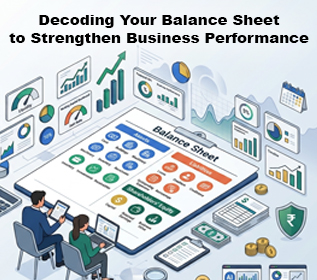
A balance sheet is often regarded as the most important financial statement of a business. While many business owners naturally focus on sales, revenue, and profits, the balance sheet tells a much deeper story about the financial strength and stability of the business. It provides a clear snapshot of the company’s financial position at a given point in time by answering three important questions:
- What does the business own?
- What does it owe?
- How much belongs to the owners?
Understanding a balance sheet does not require an accounting background. Even a basic understanding can help business owners make better financial decisions, assess liquidity, evaluate debt levels, identify financial risks, and plan for sustainable growth with greater confidence.
The Balance Sheet at a Glance
Every balance sheet is built on one simple but fundamental accounting principle:
Assets = Liabilities + Shareholders’ Equity
This equation means that everything the business owns (assets) has been financed either through borrowings and obligations (liabilities) or through the owners’ investment and accumulated profits (equity). Maintaining this balance is essential to understanding the financial health of any business.
1. Assets – What the Business Owns
Assets represent the economic resources owned by the business. They typically include cash and bank balances, inventory, trade receivables, investments, and fixed assets such as land, buildings, machinery, equipment, and vehicles. These are the resources that enable the business to operate and generate future income.
While reviewing the asset side of the balance sheet, ask yourself:
- Is the business maintaining adequate cash to meet its daily operational needs?
- Are customers taking longer to pay their outstanding dues?
- Is inventory increasing without a corresponding increase in sales?
- Is the company investing in assets that support future growth and productivity?
A healthy asset structure generally reflects efficient operations, prudent financial management, and the ability of the business to generate long-term value.
2. Liabilities – What the Business Owes
Liabilities represent the financial obligations of the business. They include bank loans, borrowings, amounts payable to suppliers, taxes payable, employee-related liabilities, and other outstanding obligations.
Debt is not necessarily a concern. In fact, when managed wisely, borrowings can help businesses expand operations, invest in new opportunities, and generate higher returns. However, continuously increasing borrowings without corresponding growth in profits or cash flows may indicate financial stress and increase repayment risks.
It is equally important to evaluate whether the business has sufficient current assets to comfortably meet its short-term liabilities. Strong liquidity ensures that daily operations continue smoothly without unnecessary financial pressure.
3. Shareholder’s Equity – The Owners’ Stake
Shareholder’s equity represents the owner’s financial interest in the business. It comprises the capital invested by the owners along with accumulated profits retained over the years after meeting all expenses and obligations.
Growing reserves and retained earnings generally indicate that the business is consistently generating profits and strengthening its financial position. Conversely, a declining net worth or erosion of equity may serve as an early warning sign of financial weakness that deserves immediate attention. A steadily growing equity base also enhances the confidence of lenders, investors, and other stakeholders.
How to Analyse a Balance Sheet
Reading a balance sheet is not about looking at individual numbers in isolation, it is about understanding the relationships between them and the trends they reveal over time.
Begin by comparing the balance sheet over the last three to five years. Trend analysis often provides far more meaningful insights than a single year’s figures. Rising debt, declining cash balances, increasing receivables, or growing inventory levels can highlight emerging issues that may not be immediately visible in the profit and loss account.
Next, evaluate the company’s liquidity. A financially healthy business should maintain sufficient current assets to comfortably meet its short-term obligations. Persistent liquidity shortages can disrupt day-to-day operations even if the business continues to report accounting profits.
It is equally important to examine the level of borrowings. Debt can accelerate growth when supported by strong cash flows and profitable operations, but excessive leverage increases financial risk, interest costs, and dependence on external financing.
Finally, assess the quality of assets. Large amounts locked in slow-moving inventory, obsolete stock, or overdue receivables can significantly reduce cash availability and limit the company’s financial flexibility, even when the balance sheet appears strong on paper.
Common Red Flags
Certain indicators deserve closer attention during a balance sheet review, including:
- Rapid increase in debt without corresponding growth in business operations.
- Declining cash balances despite reported profits.
- Significant rise in receivables or inventory over successive years.
- Continuous losses reducing shareholders’ equity.
- Large unexplained balances under loans, advances, or other assets.
These warning signs do not necessarily indicate that a business is in financial trouble. However, they should prompt further investigation to understand the underlying reasons and enable timely corrective action before small issues develop into larger financial challenges.
To summarize, a balance sheet is much more than a statutory compliance document – it is a powerful snapshot of a company’s financial health. By understanding the relationship between assets, liabilities, and shareholders’ equity, business owners can make informed decisions regarding expansion, borrowing, investments, working capital, and cash flow management.
Regularly reviewing your balance sheet helps identify risks early, strengthen financial discipline, improve resource allocation, and provide valuable insights into the long-term stability and resilience of the business. When analysed alongside the profit and loss account and the cash flow statement, it becomes an indispensable tool for effective financial management and strategic decision-making. While understanding a balance sheet is essential, interpreting it effectively often requires professional expertise. Financial Advisors can provide valuable insights, identify potential risks, ensure compliance, and help businesses make informed financial decisions with confidence