
Setting the Scene
India’s retail inflation has been on a steady upward trajectory through 2026. After dipping to multi-year lows in late 2025, Consumer Price Index (CPI) inflation has risen for several consecutive months, from around 2.7% in January to 4.45% by July 2026, with food inflation running even higher at over 5.5%. Rural India, where food and fuel account for a larger share of household expenditure, is feeling the impact more sharply than urban centres. For finance and accounts teams, this is not merely a macroeconomic talking point. Rising and uneven inflation can influence how costs are recognised, how assets are valued, how margins are protected, and how investors interpret a company’s financial performance. This article examines how Indian firms are — and should be — adjusting their financial statements and pricing strategies in this environment.
Why Inflation Complicates Financial Reporting
Traditional financial statements are largely based on the historical cost convention, under which assets and transactions are recorded at the price paid when the transaction occurred. In a low-inflation environment, this provides a reasonable basis for financial reporting. However, when prices rise steadily, historical-cost accounting can create distortions in the financial picture in three key areas:
1. Understated asset values — Land, buildings, and plant acquired years ago may remain recorded at values significantly below their current replacement cost. This can understate the economic value of the company’s asset base.
2. Overstated profits — Depreciation based on old, lower asset values may not adequately reflect the current cost of replacing those assets. As a result, reported profits may appear higher than the underlying economic profit, potentially influencing taxes and dividends.
3. Distorted inventory and COGS — Under FIFO, older and generally cheaper inventory is matched against current selling prices During periods of rapidly rising input costs, this can result in reported margins that are higher than the margins the business would earn based on current replacement costs.
None of this means that the numbers are “wrong” under Indian Accounting Standards (Ind AS), where historical cost remains an important measurement basis. However, it does mean that reported profit during an inflationary period may not fully reflect the cash-generating capacity and replacement economics of the business unless management considers the effects of inflation while interpreting the numbers.
How Ind AS Handles Inflation
India does not generally mandate a separate system of inflation-adjusted or current-cost accounting for companies. However, several provisions within the Ind AS framework are relevant when inflationary pressures become significant:
Ind AS 29 (Financial Reporting in Hyperinflationary Economies) applies when an entity’s functional currency is that of a hyperinflation economy, based on a combination of qualitative and quantitative indicators. However, the standard may become relevant for Indian multinational companies consolidating subsidiaries operating in hyperinflationary economies abroad.
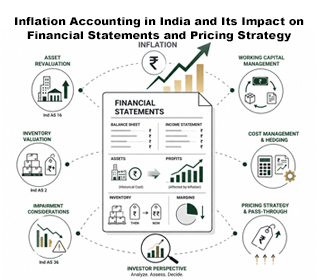
The revaluation model under Ind AS 16 (Property, Plant and Equipment) allows companies, where permitted and appropriately applied, to carry certain classes of fixed assets at revalued amounts based on fair value rather than depreciated historical cost. This can provide a more current view of the value of assets, particularly for businesses with significant property and infrastructure holdings.
Inventory valuation under Ind AS 2 requires inventories to be measured at the lower of cost and net realisable value. Cost may be determined using methods such as FIFO or weighted average cost. The method applied can have a meaningful impact on reported margins when input prices are rising rapidly, making consistent application and appropriate disclosure important.
Impairment testing under Ind AS 36 can become particularly relevant during inflationary periods. Higher interest rates and discount rates can reduce the present value of future cash flows and potentially trigger impairment for assets or cash-generating units where expected returns have not kept pace with changing economic conditions.
In short: Indian firms are not generally required to restate their financial statements for general inflation. However, several accounting standards provide mechanisms and measurement choices that can help management present financial information more meaningfully, while appropriate analysis and disclosures can help stakeholders understand the underlying economic impact of inflation.
How Firms Are Adapting to Rising Costs
1. Selective Asset Revaluation. Capital-intensive sectors such as cement, steel, real estate, and infrastructure may consider the Ind AS 16 revaluation model for eligible classes of assets where it provides a more meaningful representation of their economic value. A stronger asset base can also influence financing discussions, although revaluation should not be undertaken merely to improve the appearance of the balance sheet.
2. Tighter Working Capital Management. With input costs financing costs under pressure, finance teams are focusing closely on receivable collection, inventory levels, and supplier credit terms. Businesses are shortening receivable cycles, renegotiating supplier payment terms, and adopting more efficient inventory practices to minimise the cash locked into increasingly expensive working capital.
3. Hedging Input Costs. Companies with significant commodity exposure, including FMCG, auto components, manufacturing, and construction, may use appropriate hedging mechanisms and forward contracts to manage volatility in key inputs. The objective is to reduce the gap between movements in input costs and the company’s ability to adjust selling prices.
4. Enhanced Disclosure in MD&A. Under SEBI’s Listing Obligations and Disclosure
Requirements (LODR), listed companies provide management discussion and analysis covering material developments and their impact on operations. Increasingly transparent commentary on inflation, input costs, margins, pricing actions, and business outlook can give investors context that the historical-cost financial statements alone may not provide.
5. Reviewing Depreciation and Useful-Life Estimates. Companies may periodically reassess asset useful lives, residual values, and depreciation methods where appropriate, ensuring that these estimates continue to reflect the expected pattern of economic consumption. Such reviews can help prevent depreciation charges from becoming disconnected from the actual economic use of assets.
Pricing Strategy in an Inflationary Environment
Adjusting the financial statements is only one part of the response. The other is protecting margins in real time through an effective pricing strategy:
- Staggered, smaller price hikes rather than one large correction can help businesses manage cost increases while reducing the risk of a sudden demand shock. This approach is commonly seen in consumer-facing sectors.
- Shrinkflation and pack-size engineering allow businesses to maintain familiar price points, particularly at psychologically important levels such as ₹10 or ₹20, while adjusting product quantities. This approach has been particularly relevant in price-sensitive consumer markets.
- Premiumisation involves shifting the product mix towards higher-margin variants, allowing businesses to absorb some cost inflation without increasing prices across the entire portfolio.
- Dynamic and tiered pricing is increasingly relevant in services, travel, hospitality, and e-commerce, where prices can respond more quickly to changes in demand, operating costs, and market conditions rather than relying solely on periodic list-price revisions.
- Cost pass-through clauses in B2B and government contracts, particularly in construction and infrastructure, can protect margins through contractual escalation mechanisms linked to recognised cost or price indices, rather than relying solely on unilateral price increases.
What This Means for Financial Statement Users
For analysts, lenders, and investors reviewing Indian company accounts in the current environment, a few checks are worth applying:
- Compare reported profit growth against volume growth — if profit is rising significantly faster than volumes, part of the increase may be attributable to inflation-driven price increases rather than genuine operational improvement.
- Examine whether capex and depreciation adequately reflect the current economic cost and replacement requirements of assets, rather than relying solely on historical book values.
- Read the MD&A commentary on input cost trends, pricing actions, and hedging, rather than focusing only on headline P&L figures.
- Monitor working capital ratios, including inventory days and receivable days, for early indications of inflation-driven cash pressure.
Conclusion
India is not experiencing a hyperinflation environment, but the gradual rise in CPI through 2026 is sufficient to influence how businesses interpret financial performance, manage costs, and protect margins. Ind AS does not generally require companies to restate their financial statements for ordinary inflation, but it provides relevant accounting mechanisms and requires management to exercise sound judgement in areas such as asset measurement, inventory valuation, impairment, depreciation, and disclosure. On the commercial side, companies that manage inflation effectively are combining financial discipline with thoughtful pricing strategies that protect margins without unnecessarily weakening demand. For anyone analysing Indian financial statements today, the numbers on the page are only part of the story — the other part lies in understanding what inflation is doing beneath those numbers. Financial advisors can help businesses navigate inflation by assessing its impact on profitability, cash flows, pricing, and investments, while ensuring sound financial reporting and informed, long-term decision-making
Figures referenced: India CPI inflation was 4.45% YoY in July 2026 (provisional), per the Ministry of Statistics and Programme Implementation (MoSPI), continuing an upward trendfrom 2.74% in January 2026.