
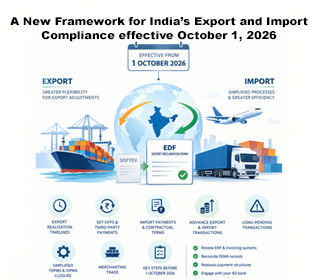
India’s foreign exchange framework for exports and imports is set for a significant overhaul from 1 October 2026. The Reserve Bank of India’s Foreign Exchange Management (Export and Import of Goods and Services) Regulations, 2026, together with the accompanying Directions, aim to simplify compliance, provide greater flexibility to businesses and give Authorised Dealer (AD) banks a more significant role in administering the framework.
The new framework consolidates the regulatory treatment of exports of goods, services and software, while introducing changes across export declarations, realisation timelines, set-offs, third-party payments, import payments, advances, merchanting trade and EDPMS/IDPMS compliance.
The new framework consolidates the regulatory treatment of exports of goods, services, and software, while introducing changes across export declarations, realisation timelines, set-offs, third-party payments, import payments, advances, merchanting trade and EDPMS/IDPMS compliance. While the replacement of SOFTEX with the Export Declaration Form (EDF) has received considerable attention, the impact of the new framework extends much further.
A Unified Export Declaration Framework
Under the new Regulations, exporters of goods and services will use the EDF.
For goods, the shipping bill will be deemed to constitute the EDF for exports through EDI ports. For services, the EDF is generally required within 30 days from the end of the month in which the invoice is raised. An exporter may submit a single EDF covering services provided to one or more recipients during a month.
Exporters of services other than software may alternatively submit the EDF on or before receipt of payment. The AD bank may extend the filing period where it is satisfied with the reasons for delay.
The change therefore extends beyond software exporters and will require service exporters across sectors to review their reporting and invoicing processes.
Longer Timeline for Export Realisation
The new framework provides a general 15-month period for realisation and repatriation of export proceeds.
For goods, the period is generally calculated from the date of shipment, while for services it is calculated from the date of invoice. For goods exported to an overseas warehouse, the period is calculated from the date of sale from the warehouse.
For goods, the period is generally calculated from the date of shipment, while for services it is calculated from the date of invoice. For goods exported to an overseas warehouse, the period is calculated from the date of sale from the warehouse.
Where exports are invoiced and/or settled in Indian Rupees, the period is extended to 18 months. An AD bank may permit an extension beyond the prescribed period where the exporter provides reasons for the delay and the bank is satisfied with them.
This provides greater flexibility for businesses operating with longer international credit cycles.
Greater Flexibility in Export Adjustments
The new Regulations provide a more streamlined mechanism for cases where the full export value is not realised.
An AD bank may permit reduction in export realisation where the exporter provides reasons for under-realisation or non-realisation. For exports up to ₹10 lakh per shipping bill or invoice, such reduction, including non-realisation of the full export value, may be permitted based on an exporter declaration.
This could significantly reduce the administrative burden associated with smaller-value export transactions.
Greater Flexibility in Set-off and Third-Party Transactions
The new framework provides greater flexibility in two important areas – set-offs and third-party payments.
An AD bank may permit export receivables to be set off against import payables involving the same overseas buyer or supplier, or their overseas group or associate companies, subject to the prescribed conditions and applicable realisation period.
Third-party receipts and payments for export and import transactions may also be permitted where the AD bank is satisfied about the bona fides of the transactions.
For multinational groups and businesses with complex cross-border payment structures, these provisions could provide greater flexibility in managing settlements. Businesses should, however, maintain clear documentation supporting the commercial rationale and genuineness of such arrangements.
Import Payments Linked to Contractual Terms
The new Regulations move away from the earlier general rule requirement for remittances against normal imports to be completed within six months from the date of shipment, subject to specified exceptions.
Going forward, AD banks will monitor import payments based on the period specified in the underlying contract. Where payment is delayed, the AD bank may allow an extension after considering the reasons provided by the importer.
This is particularly relevant for businesses negotiating extended supplier credit and other flexible commercial payment terms. Importers should ensure that contractual terms are clearly documented and aligned with actual payment arrangements.
Advance Payments with Greater Flexibility
The new framework provides greater flexibility for advance export receipts and import payments, while strengthening bank oversight.
For advance export receipts, the exporter is required to route the advance and subsequent export realisation through the same AD bank. A change of AD bank is permitted provided both banks are informed. A similar mechanism applies to advance import payments.
An AD bank may permit advance import remittances after satisfying itself about the genuineness of the requirement and may prescribe thresholds beyond which a standby Letter of Credit or guarantee may be required.
However, advance remittance for import of gold or silver is not permitted, subject to applicable exceptions. Businesses should therefore review their advance-payment arrangements and ensure that banking and documentation processes are aligned with the new requirements.
Consequences of Long-Pending Transactions
Greater flexibility does not mean indefinite open exposures.
Where an import does not materialise, and the advance is not repatriated within the permitted period, future advance import payments may become subject to an unconditional and irrevocable standby Letter of Credit or guarantee.
Similarly, where export proceeds remain unrealised for more than one year beyond the due date or extended period, further exports may be required to be undertaken only against full advance payment or an irrevocable Letter of Credit.
Businesses will therefore need stronger ageing, follow-up and exception-management mechanisms for outstanding export and import transactions.
Simplified EDPMS and IDPMS Closure
The Regulations provide specific relief for smaller transactions.
For exports where the shipping bill or service invoice is up to ₹10 lakh, EDPMS entries may be closed based on an exporter declaration that the payment has been realised, either fully or otherwise. Such declarations may also be submitted quarterly for bulk closure.
A similar mechanism is available for imports up to ₹10 lakh through IDPMS.
AD banks are also empowered, subject to prescribed conditions, to close certain entries involving export or import advances where the underlying transaction has not materialised and recovery or repatriation is not possible. For businesses with large volumes of smaller-value transactions, these provisions could help reduce the burden of maintaining long-pending system entries.
What Should Businesses Do Before 1 October 2026?
The transition should not be viewed merely as a change from SOFTEX to EDF. Businesses should undertake a broader review of their FEMA compliance framework before 1 October 2026.
Key actions should include:
- Transitioning existing SOFTEX processes to the new EDF mechanism.
- Assessing ERP and invoicing systems for EDF reporting requirements.
- Reviewing export receivables and ageing, including long-pending exposures.
- Reconciling and closing outstanding EDPMS and IDPMS entries.
- Reviewing third-party payment and set-off arrangements.
- Aligning import-payment monitoring with contractual terms.
- Reviewing outstanding export and import advances.
- Assessing merchanting trade arrangements.
- Ensuring consistency across FEMA, GST, STPI and SEZ documentation.
- Engaging with AD banks on revised documentation, approval requirements and internal SOPs.
The larger shift is towards a more flexible, principle-based and bank-led FEMA compliance framework. While businesses may gain greater flexibility, they will also need stronger documentation, monitoring and internal controls.
Preparing ahead of 1 October 2026 can help businesses minimise compliance gaps and ensure a smoother transition.