
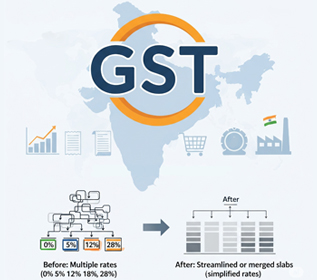
Since its rollout in 2017, the Goods and Services Tax (GST) has seen several structural refinements. One of the most anticipated reforms currently under discussion is GST rate rationalisation, aimed at simplifying the tax structure and addressing long-standing concerns from industry stakeholders.
How GST is Currently Structured
Currently, the GST regime consists of four primary tax slabs—5%, 12%, 18%, and 28%—along with exempted and zero-rated categories. Below is an indicative distribution of goods across these slabs:
- 5% Slab: Includes essential items such as food grains, life-saving medicines, and other basic necessities, accounting for approximately 14–15% of all GST listed goods.
- 12% Slab: Mid-range items such as processed foods, toothpaste, and ready-made garments account for approximately 20%.
- 18% Slab: A substantial portion of goods and services such as soaps, restaurant services, and industrial inputs falls under the 18% slab, accounting for approximately 43–45% of all GST items.
- 28% Slab: Covers luxury items, automobiles, and sin goods such as tobacco, accounting for approximately 7–8% of all GST rated items.
- Exempted/Zero-rated: Includes essential services and goods such as unbranded food items, education, and healthcare, making up around 15% of the total.
Although this structure was initially designed to balance revenue generation with affordability, it has gradually led to classification disputes, inverted duty structures, and increased compliance burdens.
Industry Expectations from GST Rat Rationalisation
Industry stakeholders have consistently raised concerns about the complexity and inefficiencies of the current multi-slab structure. Their key expectations from the proposed rationalisation include:
- Merging the 12% and 18% slabs to reduce ambiguity, streamline compliance, and minimise litigation.
- Correcting the inverted duty structure, especially in sectors like textiles, footwear, fertilisers, and packaging, where output tax is lower than input tax, resulting refund accumulation and blocked working capital.
- Enhancing predictability in tax incidence, enabling more accurate pricing strategies and efficient procurement planning.
- Implementing changes in a phased manner to ensure a smooth transition and avoid disputes related to anti-profiteering provisions.
A rationalised GST structure is expected to improve compliance, minimise classification disputes, and foster a more transparent and business-friendly tax ecosystem.
Government’s Approach: A Phased and Consultative Strategy
The GST Council, chaired by the Union Finance Minister, is actively evaluating proposals submitted by the Group of Ministers (GoM) and the fitment committee. Although the final report was deferred during the 55th Council meeting in December 2024, there are strong indications that a broad consensus is beginning to take shape.
Key proposals under discussion:
- Reassigning items from the 12% slab to either 5% or 18%, as part of a phased transition toward a three-rate GST structure.
- Resolving inverted duty structures through targeted rate adjustments in affected sectors.
- Implementing changes gradually to give businesses adequate time for recalibration and to minimise disruptions in supply chains.
The upcoming 56th GST Council meeting may prove to be a turning point in India’s indirect tax landscape. If the Council approves the proposed rationalisation roadmap, it could pave the way for a more streamlined, equitable, and efficient GST regime—one that balances the interests of industry, government revenue, and the common citizen.
All eyes are now on the Council’s next move, as this much-needed course correction could shape the future trajectory of GST in India. As the nation awaits this key decision, the hope is for a reform that simplifies compliance, supports growth, and strengthens economic transparency.