
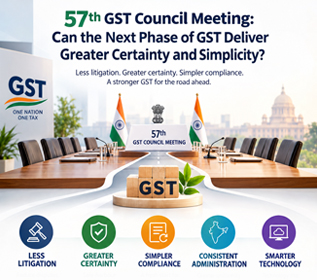
The 57th GST Council Meeting is scheduled for 7 October 2026 in New Delhi, with the preparatory Officers’ Meetings scheduled for 5 and 6 October. The meeting, which was originally scheduled for 12 September, has now been rescheduled.
For businesses, tax professionals and the wider GST community, the upcoming meeting assumes considerable importance. After almost nine years of GST, the focus is no longer merely on introducing reforms, but on making the existing system simpler, more predictable and easier to comply with.
The question now is not just what more can be added to GST, but how effectively the existing framework can be refined to deliver greater certainty and ease of doing business.
Looking Back: GST Has Come a Long Way
Since its introduction in 2017, GST has undergone significant transformations.
From the initial challenges surrounding implementation and technology to rate rationalisation, e-invoicing, return simplification and technology-driven compliance, the GST framework has continuously evolved.
The willingness of the Government and the GST Council to consider industry concerns, address practical difficulties and make course corrections has been one of the key strengths of the GST journey.
GST today is considerably more mature than it was during its initial years.
GST today is considerably more mature than it was during its initial years. Businesses and professionals have also adapted to a tax regime that has progressively become more technology-driven and data-oriented.
The next phase, therefore, should focus on certainty, consistency and ease of doing business.
What Could Businesses Hope For?
While the detailed agenda of the 57th GST Council Meeting is awaited, there are a few areas that, from a taxpayer and professional perspective, deserve particular attention.
Reducing GST Litigation:
One of the biggest concerns for businesses today is the growing volume of GST litigation, particularly around Input Tax Credit.
Where a taxpayer has entered into a genuine transaction, holds a valid invoice, has received the goods or services and has complied with the applicable conditions, there should be greater certainty around the availability of credit.
A practical safe-harbour mechanism for genuine transactions, while maintaining strong safeguards against fraudulent claims, could help reduce unnecessary notices, disputes and litigation. Such an approach could also allow tax authorities to focus their resources more effectively on transactions that genuinely warrant investigation.
The objective should be simple: strong action against fraud, but greater protection for genuine businesses.
A Fresh Start for Legacy Procedural Lapses:
The early years of GST were a learning period for everyone — taxpayers, professionals and the administration.
There were new systems, new forms, evolving procedures and several areas where the law and its implementation developed over time.
Businesses that made bona fide procedural or technical errors during this transition should not necessarily continue to carry the burden of legacy issues indefinitely, particularly where there was no revenue loss or fraudulent intent.
A carefully designed amnesty for genuine procedural and technical lapses from the early years of GST, while keeping fraud and deliberate tax evasion outside its scope, could help businesses close old matters and move forward. Such a measure could provide a much-needed reset, allowing both taxpayers and the administration to devote greater attention to current compliance rather than prolonged disputes over historical procedural issues.
One Nation, One Tax — One Consistent Experience:
The idea of GST was not merely to create a common tax structure, but also to create a more seamless business environment across India.
Businesses operating across multiple States should ideally experience consistent registration processes, documentation requirements and administrative procedures.
Greater standardisation across States would make GST more predictable, reduce unnecessary compliance effort and minimize the possibility of businesses having to navigate different interpretations or procedures for similar requirements. A more uniform taxpayer experience would also strengthen one of the fundamental promises of GST — creating a truly integrated national market.
Simplification of Compliance:
GST has already made significant progress in using technology to facilitate compliance.
The next step should be to ensure that technology actually reduces the compliance burden, rather than simply moving complex processes online.
Where information is already available with the Government through GST returns, e-invoices and other systems, taxpayers should not repeatedly be required to provide the same information. The objective should be to move towards a more intelligent compliance framework where technology enables data sharing, pre-filled information and risk-based scrutiny, rather than creating additional layers of reporting. In other words, digitalisation should ultimately mean less duplication, fewer manual interventions and greater ease of compliance.
Looking Ahead,
GST has spent its first nine years building the system.
The next phase should be about building confidence in the system.
For businesses, the priorities are clear:
Less litigation
Greater certainty
Simpler compliance
Consistent administration
The 57th GST Council Meeting provides another opportunity to take GST closer to its original vision of a simpler, technology-driven, and business-friendly indirect tax regime.
The detailed agenda is awaited, and the final recommendations will determine the direction of the next phase. Whatever the outcomes, the emphasis should remain on reforms that improve the taxpayer experience while strengthening the integrity of the GST framework.
Nearly a decade into GST, the next big reform may not necessarily be another major structural change. It could simply be making the existing system work better, work consistently and work with greater certainty for the genuine taxpayer. For now, the expectation is straightforward:Make GST easier for the genuine taxpayer, while keeping the system tough on fraud.