
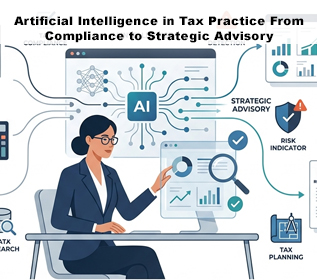
For decades, tax practice followed a predictable rhythm: gather documents, enter numbers, cross-check them against the previous year’s return, research grey areas, and hope filing season ends before burnout does. That rhythm is now changing, not because the tax code has become simpler, but because artificial intelligence is quietly transforming how the work gets done.
This transformation is not merely about automation; it is about redefining the role of tax professionals – from processors of information to strategic advisors who drive business value.
This shift is not incremental – it is structural.
From Data Entry to Data Judgment
The most immediate shift is in the grunt work. Optical character recognition and machine learning models can now extract structured data with increasingly high accuracy. Tools powered by large language models can analyse a client’s financial statements, flag inconsistencies, and populate draft returns in a fraction of the time a junior associate would typically require.
This doesn’t eliminate entry-level tax roles; it changes what those roles are designed to accomplish. Instead of spending hours transcribing numbers, junior staff is increasingly required to review AI-generated drafts, validate outputs, and handle the judgment calls that software cannot make. The work is moving up the value chain faster than firms are accustomed to training their people for.
Research That Used to Take Days
Tax research has traditionally involved navigating the Internal Revenue Code, regulations, revenue rulings, and case law, often across multiple databases, to answer a single client question. AI-powered research assistants can now synthesize this material within minutes, surface relevant precedent, and prepare a first-pass memo citing the applicable authorities.
The caveat every practitioner already knows is that these tools can be confidently wrong. Hallucinated citations and misapplied rules remain genuine risks, which means AI-generated research is best treated as a fast first draft rather than a final answer. The professional’s role increasingly shifts towards verification, interpretation, and application rather than simply locating information.
Real-Time Advisory, Not Just Annual Filing
Perhaps the more significant shift is strategic. AI tools that continuously monitor a business’s transactions can identify tax-planning opportunities as they arise, an entity structure that may no longer be appropriate, a credit that has gone unclaimed, or a state nexus issue quietly developing in the background. This moves tax practice away from a once-a-year compliance exercise towards continuous, proactive advisory.
For firms, this represents a business-model question as much as a technology question. Billing by the hour for form preparation becomes less sustainable when AI significantly reduces preparation time; the value increasingly lies in advice, professional judgment, and client relationships, areas that are harder to automate and easier to position as premium services.
Audit Support and Risk Detection
On the compliance side, tax authorities themselves are increasingly adopting AI to detect anomalies and identify returns for more targeted audits, raising the stakes for accuracy on the preparer’s side. In response, firms are deploying similar pattern-detection tools defensively, running returns through models designed to identify the types of anomalies and red flags that could attract scrutiny before a return is filed.
What Isn’t Changing
Certain aspects of tax practice remain inherently human. Building and sustaining client relationships, navigating discussions with tax authorities, and exercising professional judgment in areas of ambiguity continue to depend on experience, context, and accountability—capabilities that AI cannot fully replicate.
Further, tax compliance carries clear ethical and legal responsibilities. It is the tax professional, not the software, who ultimately signs off on the return and bears responsibility for its accuracy. This fundamental distinction creates an accountability gap that technology cannot bridge.
Accordingly, AI should be viewed as an enabler that augments professional capabilities rather than a substitute for them.
The Practical Shift for Practitioners
In the near term, the evolution of tax practice is less about disruption and more about a fundamental reshaping of day-to-day responsibilities:
- Less time spent on manual data entry and more time reviewing and validating AI-generated output
- Interpreting AI-generated insights and translating them into actionable tax strategies
- A greater emphasis on advisory services as compliance work becomes increasingly automated
- New risk considerations surrounding data security, client confidentiality, and the accuracy of AI-generated outputs
Looking Ahead: The Future is Augmented, Not Automated
AI is not replacing tax professionals; it is fundamentally augmenting their capabilities. While technology is increasingly capable of handling scale, speed, and data-intensive processes, responsibility for accuracy, strategic interpretation, and client trust continues to rest firmly with the practitioner.
In practice, this shift is less about displacement and more about evolution. The tax function is moving away from a backward-looking compliance role towards a forward-looking, insight-driven advisory function. As AI tools mature, the distinction between a “tax preparer” and a “tax advisor” will continue to blur, placing greater emphasis on judgment, interpretation, and value creation.
Organizations and professionals that embrace this transformation early will not only achieve efficiency gains and stronger compliance but will also unlock enhanced decision-making capabilities. More importantly, they will position the tax function as a strategic partner to the business rather than merely a transactional necessity.
In a landscape defined by complexity, speed, and increasing regulatory scrutiny, the integration of AI into tax practice is not just an innovation – it is imperative. Ultimately, the future of tax belongs not to those who compete with technology, but to those who know how to harness it.