
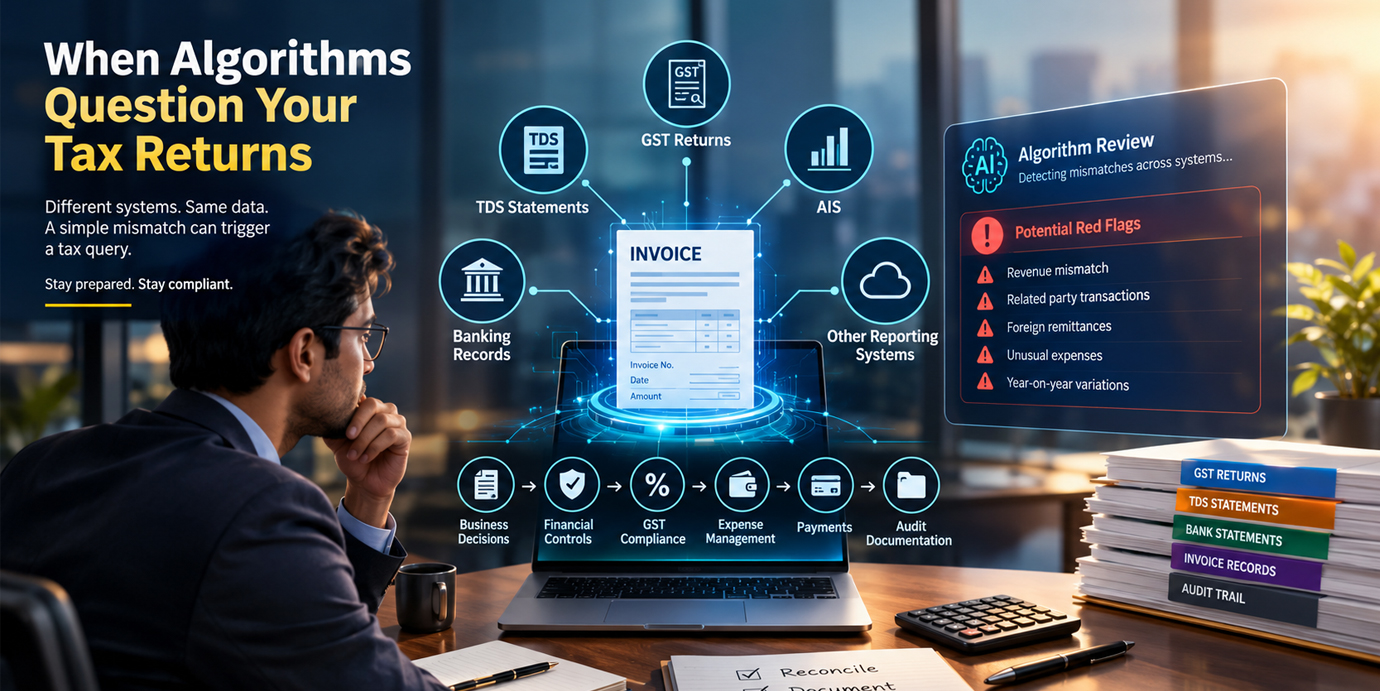
Tax disputes are changing. The next question from the tax authorities may be generated by data before it is raised by a human.
Tax administration is no longer limited to what a taxpayer reports in its income-tax return.
Today, information flows across multiple systems, including GST returns, TDS statements, the Annual Information Statement (AIS), financial transactions, foreign remittances, banking records and information reported by third parties.
The real change is not simply the availability of this data. It is the ability to connect and analyse it.
A transaction that appears routine in isolation may look unusual when compared with information available elsewhere. A mismatch, an unexpected movement in margins, a significant related-party transaction or a sharp departure from historical patterns can become a risk indicator.
That indicator may be enough to trigger a tax query.
From “What did you report?” to “Does your data reconcile?”
Consider a simple example.
A company reports revenue of INR 100 crore in its financial statements. However, information available through another tax or reporting system appears to indicate a different figure.
There may be a perfectly valid explanation, such as timing differences, advances, credit notes, differences in accounting and tax treatment, or errors in third-party reporting.
But an automated system may initially see only one thing –
“A Mismatch”
The taxpayer may therefore need to explain not only why its tax position is correct, but also why the data appears different across systems. This is where the nature of tax compliance is changing.
Data is a Risk Indicator, Not Necessarily a Tax Conclusion
An important distinction is becoming increasingly relevant: a data mismatch is a starting point for inquiry, not proof of a tax default.
- A TDS mismatch does not necessarily mean that income has been underreported.
- A GST-to-books difference does not automatically establish suppression of turnover.
- An unusual expense ratio does not, by itself, make an expense inadmissible.
- A significant related-party transaction is not inherently non-genuine or impermissible.
The system may identify the question, but the taxpayer must still establish the answer through facts, documentation and applicable law. This makes the quality of the underlying data, along with the taxpayer’s ability to explain it, increasingly important.
What Should Businesses do Differently?
Tax compliance can no longer be viewed solely as the accurate preparation of a return. Businesses should increasingly ask themselves:
“If our data is compared across different systems, will we be able to explain the differences?”
A practical tax-risk review should consider:
- Books of account versus GST returns;
- Books of account versus TDS statements and AIS information;
- Revenue versus information reported by customers or other third parties;
- Significant year-on-year movements in revenue, margins, expenses or tax positions;
- Related-party transactions and their commercial rationale;
- Foreign remittances, withholding tax and associated documentation;
- Unusual deductions, expenses or one-off transactions; and
- Transactions that deviate materially from historical patterns.
The review should also distinguish genuine errors from explainable differences and assign clear ownership for resolving each item. A reconciliation is most useful when it documents not only the difference, but also its cause, supporting evidence, and tax treatment.
The objective is not to predict every question the tax authorities may ask. It is to identify potential questions before they arise.
The New Tax Defence: Explainability
The future of tax compliance will increasingly depend on explainability.
Businesses should be able to answer three fundamental questions:
What Happened? Why Did It Happen? Can We Substantiate It?
For significant or unusual transactions, contracts, invoices, reconciliations, commercial rationale, approvals and tax analysis should be retained together. The supporting explanation should be consistent with the accounting entries, tax filings and information reported across different systems.
After all, the best time to build a tax defence is before the notice arrives.
Tax Controls Should Operate Throughout the Year
A year-end reconciliation may identify a problem, but it may be too late to reconstruct the commercial rationale or obtain missing evidence. High-risk data points should therefore be reviewed periodically, particularly after major transactions, business reorganisations, changes in revenue models, large credit notes, cross-border payments or unusual movements in margins.
The control framework should also distinguish between three outcomes: an error that must be corrected, a difference that must be reconciled and a position that must be legally defended. Treating all exceptions alike can lead either to unnecessary corrections or to inadequate explanations.
The Role of the Tax Professional is Evolving
The tax professional of tomorrow will need to examine a transaction through three lenses:
- Law – Is the position legally correct?
- Business – Is there a genuine commercial rationale?
- Data – How will the transaction appear across different systems?
A position may be legally sound and commercially justified, yet still attract scrutiny if the underlying data appears inconsistent. The role is therefore expanding beyond return preparation and legal interpretation. It increasingly involves working with finance, accounting and technology teams to identify data gaps, design effective reconciliations and establish a defensible audit trail.
That is why modern tax-risk management is moving beyond routine compliance towards data consistency, governance and explainability.
The Algorithm is not the Opponent
Technology can make tax administration more efficient and help identify genuine inconsistencies more quickly.
The challenge is not that an algorithm asks a question. The challenge is being unprepared to answer it.
Businesses that understand their data, reconcile significant differences and maintain a clear audit trail will be better positioned to respond in an increasingly data-driven tax environment.
Your next tax dispute may not begin with a notice.
It may begin with an algorithm.