
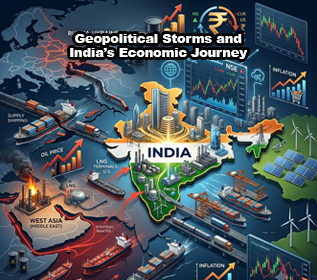
Global conflicts have increasingly demonstrated that economic boundaries are far more porous than geographical ones.
India, the world’s third-largest economy by purchasing power and one of the fastest-growing major economies, does not exist in isolation from global geopolitical developments. As 2026 has starkly demonstrated, conflicts thousands of kilometres away — particularly in West Asia — can ripple through Indian petrol pumps, stock exchanges, export terminals, and household budgets within days. With escalating tensions involving the United States, Israel, and Iran, alongside the continuing Russia-Ukraine war, India’s deep integration into global trade and energy markets has transformed distant battlefields into a matter of domestic economic concern.
Energy Security: India’s Biggest Vulnerability
Energy import dependence remains India’s single greatest exposure to global conflict. India imports over 80% of its crude oil requirements, meaning any spike in global energy prices directly fuels domestic inflation and widens the current account deficit.
This dependency became particularly acute during the 2026 West Asia conflict. India consumes an estimated 2.5 to 2.7 million barrels of crude oil per day, and nearly half of that volume transits through the Strait of Hormuz — one of the world’s most strategically sensitive maritime chokepoints, through which roughly 20% of global oil trade passes daily. When hostilities intensified, Iran’s closure of the Strait of Hormuz disrupted nearly 20% of global oil supplies, prompting the International Energy Agency to describe it as the “largest supply disruption in the history of the global oil market.”
The impact on prices was severe. Oil prices surged from approximately $60 to $120 per barrel, with the Indian crude basket briefly touching $157 per barrel. Even as tensions eased somewhat, Brent crude prices remained above $111 per barrel, increasing costs for Indian oil companies. The shipping side of the equation deteriorated as well. Insurance premiums for oil tankers rose by nearly 300% within two months, while freight costs doubled as vessels were forced to take longer and more circuitous routes to reach Indian ports such as Jamnagar and Mundra.
Cooking fuel security remains similarly vulnerable. More than 80% of India’s LPG requirements are sourced from West Asia, while the country’s strategic LPG reserves are estimated to cover only about one week of national consumption.
Inflation and the Currency
Higher energy import bills quickly translate quickly into broader inflationary pressures and currency weakness. Every $10 increase in crude oil prices widens India’s current account deficit and contributes to inflation by raising diesel prices, increasing logistics costs, and reducing consumer purchasing power.
The Indian rupee has borne a significant share of the strain. The currency depreciates sharply, recently crossing the 95/USD mark amid imported inflation and global capital outflows. Foreign Institutional Investors (FIIs) withdrew heavily from Indian markets, selling approximately $13 billion worth of debt and equity in March alone. In response, the Reserve Bank of India deployed nearly $12–15 billion from its foreign exchange reserves of approximately $723 billion, intervening in spot, forward, and offshore markets to stabilise the currency.
Equity markets reflect similar concerns. BSE-listed companies collectively lost more than ₹51 lakh crore ($5.1 trillion) in market capitalisation amid fears of a prolonged West Asia conflict, elevated crude oil prices, and sustained foreign investor withdrawals.
Sector-Specific Impacts
Steel and Metals: Higher shipping costs directly increased the cost of importing raw materials. Capesize freight rates rose from $9.80 to $12.20 per tonne within weeks of March 2026, driven by higher bunker fuel costs and disruptions around the Strait of Hormuz. This sigficantly increased the landed cost of coking coal and iron ore for Indian steel producers. Since India imports approximately 90% of its metallurgical coal requirements, primarily from Australia, domestic steelmakers remain highly exposed to global price volatility.
Aviation, Chemicals, and FMCG: Aviation profitability came under pressure as jet fuel, which accounts for 30–40% of operating costs, became more expensive. Similarly, industries such as paints, chemicals, FMCG, logistics, construction, and cement faced rising input costs, squeezing margins across sectors.
Agricultural Exports: Basmati rice exports — where the Middle East accounts for nearly 70% of demand — were adversely affected, with exporters suspending shipments due to insurance-related constraints on Gulf-bound cargo. Seafood exporters faced similar challenges. Indian seafood exporters reportedly incurred losses exceeding ₹1,500 crore, with shipments worth nearly $300 million remaining stranded at ports because of instability in the Persian Gulf region.
Metals Exports (A Silver Lining): Not all consequences were negative. Aluminium prices rose sharply as smelters in Qatar and Bahrain encountered shipping disruptions through the Strait of Hormuz. While higher aluminium prices increased costs for domestic construction and automobile sectors, they benefited Indian producers and exporters such as Vedanta and Hindalco by enabling them to realise higher export revenues.
Remittances and the Gulf Workforce
India’s large expatriate workforce in the Gulf adds both a human and financial dimension to the crisis. Nearly 9 million Indians live and work across Gulf countries, collectively remitting around $50 billion annually — equivalent to nearly 38% of India’s total remittance inflows.
The conflict disrupted this vital economic lifeline. More than 220,000 Indians have reportedly returned home because of job losses or safety concerns, with affected employment concentrated in sectors such as construction, oil services, hospitality, and retail. Reduced revenues among employers in conflict- affected economies may lead to delayed salary payments, contract terminations, or a rise in informal employment arrangements. Consequently, remittance flows face downside risks if labour market conditions across the GCC region deteriorate further.
Growth Outlook: How Much Will India Slow Down?
Estimates regarding the economic impact vary across institutions and assumptions, but most projections point to slower growth compared with pre-conflict expectations.
India’s FY27 GDP growth was initially projected at approximately 7.4–7.5%. However, a prolonged disruption could reduce growth to the 6.5–6.8% range, implying a loss of roughly one percentage point.
EY estimates that a substained conflict throughout FY27 could reduce GDP growth by approximately 1% while increasing inflation by about 1.5%.
The IMF lowered its global growth forecast to 3.1% in April 2026, warning that the West Asia conflict could trigger one of the largest energy crises in modern times. Meanwhile, the RBI maintained that India could still achieve growth of around 6.9% during FY 2026–27 despite global uncertainties.
Historical analysis by the IMF provides a sobering perspective. Countries directly involved in wars experience average output losses of approximately 7% over five years. Although India is not a direct participant in these conflicts, global economic shocks continue to transmit meaningfully into the domestic economy through multiple channels.
Policy Response and Resilience
New Delhi has not remained passive in the face of these challenges. Finance Minister Nirmala Sitharaman has highlighted several fiscal safeguards, including a ₹1 trillion Economic Stabilisation Fund established earlier in FY26. On the energy front, the government has increased commercial LPG allocations and extended support to priority sectors such as steel, where fuel substitution options remain limited. Similarly relief measures for LNG-dependent industries, however, have yet to emerge.
Officials remain cautiously optimistic about India’s underlying resilience. As S. Mahendra Dev, Chairman of the Economic Advisory Council to the Prime Minister, has observed, maintaining near-term growth of 6–7% remains achievable due to sustained public capital expenditure, robust domestic consumption, and supportive monetary policy. However, achieving the more ambitious 8% growth trajectory required to realise India’s “Viksit Bharat 2047” vision will depend heavily on a strong private investment cycle, something geopolitical uncertainty often undermines.
He has also highlighted a compounding domestic risk – forecasts of a below-normal monsoon in 2026. The interaction between energy-driven inflation and weather-related agricultural disruptions could significantly affect rural incomes by increasing input costs while simultaneously reducing agricultural yields.
Strategic Shifts and Long-Term Opportunities
Crises of this nature often accelerate structural transformation. With crude oil prices remaining in triple-digit territory, the government’s target of achieving 20% ethanol blending has evolved from an environmental objective into an economic necessity. Companies such as EID Parry have increasingly expanded into biofuel production as part of this transition.
More broadly, the conflict is reinforcing India’s efforts to reduce dependence on imported oil through accelerated investments in solar power, electric vehicles, and green energy projects. Simultaneously, India is strengthening trade relationships with alternative partners while expanding capabilities in defence, logistics, and strategic infrastructure to mitigate future vulnerabilities.
There may also be long-term benefits arising from global supply-chain realignment. As multinational corporations diversify away from conflict-prone regions, India could attract higher levels of investment, strengthening manufacturing and export capabilities. Combined with stable remittance inflows and diversified energy sourcing strategies, these developments may help cushion future external shocks.
Conclusion
The geopolitical conflicts of 2026 have underscored a fundamental reality. India’s growth story, while resilient, remains vulnerable to global disruptions. Energy import dependence continues to be the primary transmission channel through which external shocks influence inflation, currency stability, equity markets, and sector-specific costs — from steel and aviation to agriculture and exports. Remittances from the Gulf, a critical source of income for millions of Indian households, are likewise exposed to regional instability.
Nevertheless, India’s response — characterised by fiscal buffers, accelerated renewable energy adoption, diversified energy sourcing, and resilient domestic demand — reflects a degree of structural strength developed over the past decade. The key question for India’s economic trajectory through 2026 and beyond is not whether global conflicts will affect the country, but how rapidly it can reduce its dependence on volatile and conflict-prone supply chains while sustaining the investment, productivity, and growth necessary to achieve its long-term development ambitions.
This article draws on reporting and analysis published between March and April 2026 from sources including the World Economic Forum, Outlook Business, Daily Pioneer, and sector analysts examining the economic spillover effects of the West Asia conflicts on India.