
The dual system operated under the provisions of the Income Tax Act, 1961. Section 3 of the Act defined the “previous year” as the financial year immediately preceding the assessment year or, in certain cases, the period commencing from the start of a business until the end of that financial year. Section 4, being the charging provision, stipulated that income tax would be levied on the total income of the previous year at the rates prescribed for the relevant assessment year.
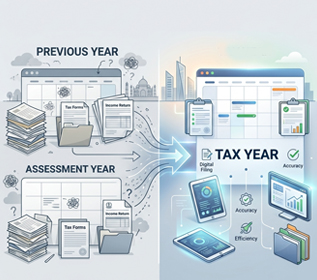
At the heart of India’s traditional tax framework lay a two-year construct that often-puzzled taxpayers. The “Previous Year” referred to the financial year in which income was actually earned, spanning from 1st April to 31st March. The “Assessment Year” denoted the twelve-month period immediately following the Previous Year, during which such income was assessed and taxed. While this system functioned efficiently from an administrative standpoint, it frequently created confusion for the lay taxpayer due to its dual-year structure.
The Income Tax Act, 2025 introduces the concept of a Tax Year, replacing the existing “previous year” and “assessment year” with a single, unified framework, and provides for the levy of income tax on the total income of each Tax Year under a clearer Section 4.
The CBDT FAQs clarify that pending matters under the repealed Act will continue seamlessly in accordance with Section 536. The provisions relating to TDS and TCS have been consolidated into unified sections aligned with the Tax Year framework, while return filing categories and due dates have been retained with a more streamlined and intuitive structure, enhancing overall ease of compliance.
Shifting from this age-old concept is likely to present implementation challenges. Taxpayers, Tax consultants, corporates, and other stakeholders will need to recalibrate their understanding and update their record-keeping systems. Resources will require proper familiarizing & training to become accustomed to the new terminology. Additionally, software systems used for tax compliance, accounting, and return preparation will need to be updated to align with the Tax Year framework.
With the introduction of the new concept, taxpayers will benefit from greater clarity and ease of understanding. Improved synchronization across notices and forms will enhance communication and help reduce errors. Additionally, better alignment with international practices will contribute to a clearer and more globally comparable understanding of India’s tax system.
Proper implementation will have a positive impact. Its success will depend on clear communication, robust system updates, and a phased approach. The concept of the Tax Year removes significant hurdles in understanding tax laws, income recognition, and deductions. This marks one of the most crucial changes introduced by the government toward simplifying tax laws and enhancing compliance.
At the heart of this transformation lies the income tax filing portal, the primary digital interface through which all compliances are undertaken, where the Central Board of Direct Taxes (CBDT) will play a pivotal role. It must adopt a proactive approach to ensure effective implementation and smooth operation of the new framework. A user-friendly interface, supported by clear instruction, robust help modules, and intuitive functionalities, will be essential to minimize confusion, especially in the initial year of transition. The success of this shift will depend significantly on well-structured taxpayer education and awareness initiatives. The CBDT must also establish clear and consistent communication channels with the tax consultants, industry bodies, and professional associations to ensure alignment across stakeholders. Thoughtful outreach and engagement will not only bring clarity but also foster confidence in embracing the new Tax Year framework. In this evolving landscape, the role of tax professionals becomes indispensable, as they will be instrumental in guiding, interpreting, and facilitating a smooth transition for taxpayers.