
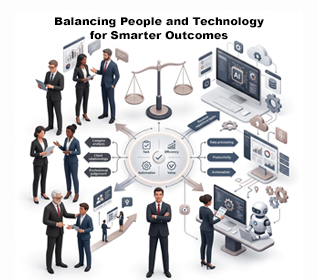
In a service-oriented business, the most important resources are people and technology. Unlike manufacturing, where machinery and physical assets play a major role, service organisations depend largely on the knowledge, skills, judgement and relationships of their people, supported by appropriate technology.
Effective resource management, therefore, is not about having the maximum number of people or the latest technology. It is about using the right resource for the right task to achieve the best possible outcome. When resources are aligned with the nature of the work, organisations can improve efficiency, productivity and the quality of their service.
The Right Resource for the Right Work
A simple example explains this well. A Mathematics book may contain hundreds of pages filled with numbers, formulas and calculations. However, if you want to know the year of India’s Independence, you would not search the Mathematics book. You would refer to a History book.
The Mathematics book is not inadequate; it is simply not the right resource for that particular requirement. Its value depends on how appropriately it is used.
The same principle applies to a service organisation. An employee may be hardworking, sincere and committed, but may not necessarily be the right person for every assignment. Similarly, sophisticated technology may be available, but it may not be appropriate for every task.
Management, therefore, needs to understand the nature of the work, the capabilities of its people and the technology available, and then determine who or what is best suited to perform the task. The objective is not merely to allocate resources but to align them with the requirements of the work.
People – The Key Resource
People remain at the heart of the service industry. They bring knowledge, experience, judgement, creativity and, most importantly, the ability to understand and interact with clients.
Employees have different capabilities and working styles. Some are self-motivated and can independently analyse situations and make decisions. Some work best when clear instructions are provided. Some are enthusiastic but require training to develop the necessary skills. Others may be extremely hardworking but may require guidance when the work involves significant judgement or analytical ability.
There is, therefore, no universally “best” employee. The objective should be to match an individual’s capabilities with the requirements of the assignment. The right person in the right role can often deliver significantly better results than simply assigning work based on availability.
People also offer certain advantages that technology cannot easily replace. They can communicate with clients through meetings and telephone calls, understand the context behind a requirement, handle exceptions, build relationships and exercise judgement in situations where there may not be a standard answer.
At the same time, people have limitations. They have emotions, varying levels of concentration, different learning abilities and individual working styles. Errors and inconsistencies can occur, particularly when employees are inexperienced or when instructions are unclear.
Therefore, effective management requires the right balance of direction, training, supervision and independence. A highly experienced employee may need only the objective and deadline, while a less experienced employee may need a defined process and regular review. Good resource management recognises these differences instead of adopting a one-size-fits-all approach.
Technology – The Enabler
Technology has transformed the way service businesses operate. It ranges from simple tools such as scanners and printers to computers, laptops, accounting and ERP systems, workflow software, automation and, increasingly, Artificial Intelligence (AI).
The appropriate use of technology can significantly improve productivity. Routine and repetitive activities can be automated, large volumes of data can be processed quickly, calculations can be performed efficiently, and information can be stored and retrieved easily. This allows employees to spend more time on analysis, decision-making and client service.
However, technology also has limitations. The latest technology is not necessarily the most appropriate technology. It should be selected based on the nature, volume and complexity of the work. A sophisticated solution may add little value if a simpler tool can perform the task effectively.
Technology also requires continuous updating. Software changes, systems become outdated, and new tools are introduced regularly. Organisations, therefore, need to invest not only in technology but also in keeping their people trained to use it effectively.
Another important risk is over-dependence on technology. Employees may sometimes accept a system-generated result without applying their own judgement. Technology can process incorrect information very efficiently, but it cannot necessarily determine whether the underlying information or conclusion is correct.
Technology should, therefore, be viewed as an enabler of human capability, not a replacement for human judgement. Its greatest value lies in helping people perform their work faster, more accurately and more effectively.
People and Technology – Working Together
The greatest benefit comes when people and technology complement each other.
For example, in a professional services firm, technology can assist in downloading documents, extracting information, performing calculations, preparing standard reports and identifying exceptions. Employees can then focus on reviewing the results, analysing issues, communicating with clients and applying professional judgement.
The same technology may also produce different outcomes depending on the person using it. An experienced employee may use a tool to analyse information and identify risks, while an inexperienced employee may simply rely on the output without questioning it. This makes training and capability development increasingly important. As technology becomes more powerful, employees need to become better at understanding, questioning and validating its output. The ability to work effectively with technology is therefore becoming as important as the technology itself.
The objective should, therefore be simple:
Automate what can be automated. Delegate what can be delegated. Review what requires judgement.
Conclusion
Efficient resource management is ultimately about putting the right resource to the right use.
People bring judgement, experience, communication and relationships, while technology brings speed, consistency, automation and processing capability. Both have their strengths and limitations. Both have their strengths and limitations. The challenge for management is to understand these strengths and limitations and create an environment where they complement rather than compete with each other.
The popular saying, “If you ask a fish to climb a tree, it will fail,” highlights the importance of assigning work according to individual capabilities. At the same time, there is no value in giving a fish a life jacket as its primary solution when it already has the skill to swim.
Similarly, organisations should not expect every person to perform every type of work, nor should they expect technology to solve every problem. The best results are achieved when management understands the strengths and limitations of both people and technology and uses each where it can create the greatest value. Ultimately, effective resource management is not about choosing between people and technology; it is about knowing when, where and how to use each of them effectively.