
Background
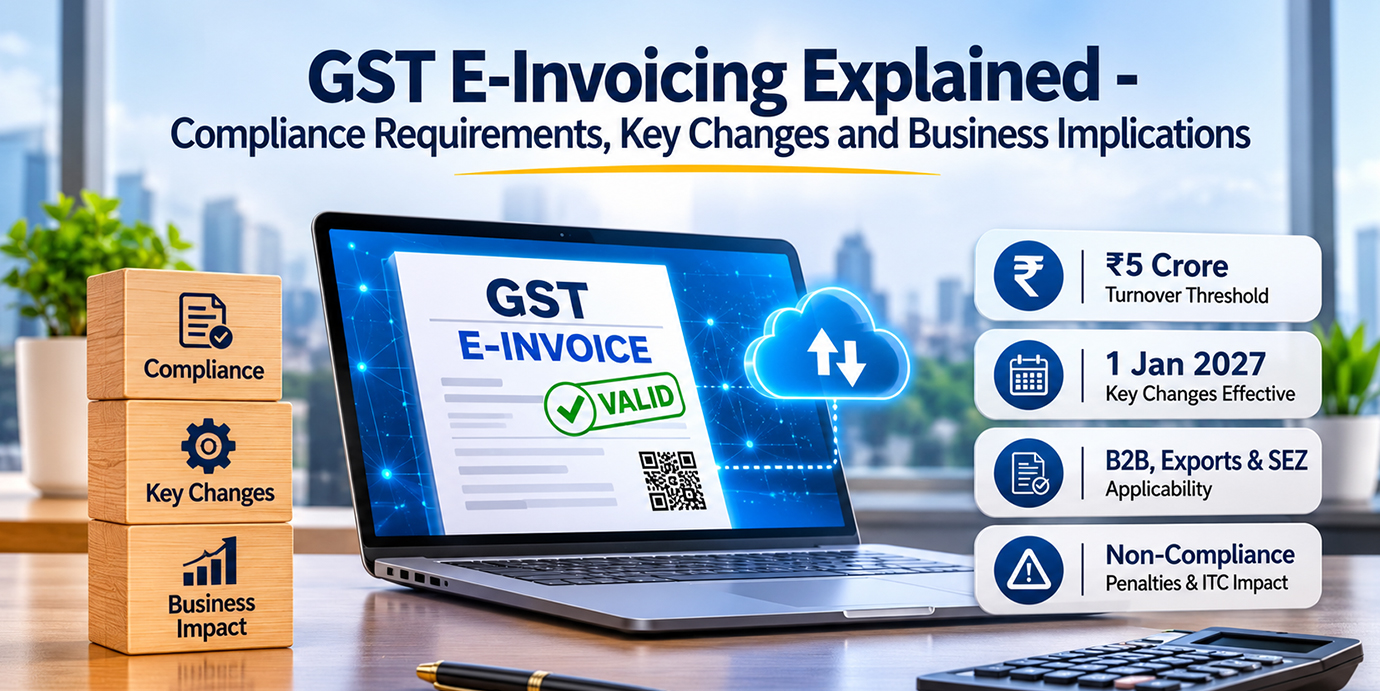
To curb GST evasion, prevent revenue leakage, and improve transparency in tax administration, the Government introduced the e-invoicing system for the electronic reporting and authentication of specified invoices and related documents. Under this system, registered taxpayers covered by the e-invoicing provisions are required to report the details of specified tax invoices, export invoices, debit notes and credit notes, in the prescribed format, to an Invoice Registration Portal (IRP). The IRP validates the information and generates a unique Invoice Reference Number (IRN), along with a digitally signed QR code, which is returned to the taxpayer.
It is important to understand that e-invoicing does not mean that the Government generates the invoice. The taxpayer continues to prepare the invoice through its accounting, billing or Enterprise Resource Planning (ERP) system. The invoice details are subsequently reported to the IRP registration and authentication.
Applicability
Over the years, the turnover threshold for e-invoicing has been progressively reduced to bring more businesses within its ambit. Presently, e-invoicing is mandatory for a registered person whose aggregate turnover in any preceding financial year from FY 2017-18 onwards exceeds ₹5 crore. The threshold of ₹5 crore became effective from 1 August 2023.
The aggregate turnover is determined on a PAN-wise, all-India basis, covering the turnover of all GST registrations under the same PAN. Accordingly, once the prescribed threshold is crossed in any relevant preceding financial year, the e-invoicing requirement generally applies to the eligible GST registrations of the entity, subject to the specific exemptions prescribed under GST law.
Further, once a taxpayer becomes liable to comply with the e-invoicing provisions, the requirement does not cease merely because its aggregate turnover subsequently falls below the prescribed threshold.
Important Change from 1 January 2027
The Government has further expanded the scope of e-invoicing through Notification No. 04/2026–Central Tax dated 26 October 2026, with effect from 1 January 2027. Under the amended provisions, the e-invoicing framework will additionally cover the following transactions:
• Supplies received from an unregistered person where GST is payable by the recipient under the Reverse Charge Mechanism (RCM).
• Import of services, where GST is payable by the recipient under the applicable reverse charge provisions.
For these specified inward supplies, the recipient will be required to comply with the applicable self-invoicing and e-invoicing requirements, subject to the prescribed conditions and exemptions. This amendment marks a significant expansion of the existing framework, which primarily covered specified outward supplies, to include certain inward supplies as well. Businesses should accordingly review their procurement processes, RCM transactions and import-of-services arrangements well in advance of the implementation date.
Generation of E-Invoice
E-invoices are generated through the Invoice Registration Portals (IRPs) notified by the Government for this purpose. Taxpayers can choose from different modes of reporting depending on their business requirements, transaction volumes, and level of system integration. The available modes broadly include:
• Web-based portal
• API-based
• Mobile application-based reporting
• Offline tool-based reporting
• GST Suvidha Provider (GSP)-based integration
• Other system-integrated solutions
These options enable businesses to select an appropriate reporting mechanism while ensuring compliance with the prescribed e-invoicing requirements.
Important Points to be Noted
1. Prerequisite for Generation of E-Invoice
The taxpayer should be a registered person covered under the e-invoicing provisions and should have the necessary access to the e-invoice system. The relevant document, such as a tax invoice, debit note, or credit note, must first be prepared in accordance with the applicable GST provisions. The details of the document are then reported to the IRP in the prescribed schema for validation and generation of the IRN and digitally signed QR code. The taxpayer should ensure that the information submitted is accurate and consistent with the underlying transaction and applicable GST requirements.
2. Time Limit for Generation of E-Invoice
With effect from 1 April 2025, taxpayers having an Annual Aggregate Turnover (AATO) of ₹10 crore or more are not permitted to report invoices, debit notes or credit notes on the IRP if they are more than 30 days old from the date of the document. For instance, an invoice dated 1 April 2025 must be reported on the IRP within the prescribed 30-day window. The IRP will not permit IRN generation once this reporting period has expired.
As a good business practice, taxpayers should generate and report e-invoices promptly after preparing the corresponding tax invoice, debit note, or credit note, rather than waiting until the end of the reporting period. This will help avoid reporting delays and potential compliance issues.
3. Cancellation / Amendment
Once an e-invoice has been successfully generated, it cannot be amended or modified directly on the IRP. However, an e-invoice/IRN can generally be cancelled within 24 hours of its generation, subject to the applicable conditions. If the 24-hour period has elapsed, cancellation or modification cannot be carried out through the IRP. The taxpayer may have to resort to the appropriate GST-compliant mechanism, such as issuing a credit notes or making the necessary adjustments in the relevant GST returns, wherever applicable. Further, where an e-way bill has already been generated against the e-invoice, the e-way bill must be cancelled, wherever permissible, before proceeding with the cancellation of the IRN.
4. Integration with GST Returns and E-Way Bills
The details of e-invoices reported through the IRP are automatically transmitted to the GST system and are used for auto-population of the relevant details in GSTR-1. However, auto-population does not eliminate the taxpayer’s responsibility to verify the information. Businesses should regularly reconcile the auto-populated details with their books of account and ensure that the GSTR-1 contains complete and accurate information before filing. The e-invoice and e-way bill systems are also integrated. Relevant invoice details can be used for generating the e-way bill, thereby reducing duplicate data entry and improving the efficiency of compliance processes.
5. E-Invoice for Invoices, Debit Notes and Credit Notes
Registered taxpayers covered under the e-invoicing provisions are required to generate e-invoices for specified transactions, including:
• Business-to-Business (B2B) supplies, including applicable supplies to registered government entities.
• Supplies to Special Economic Zone (SEZ) units/developers, as applicable.
• Exports, with or without payment of tax.
• Debit notes and credit notes relating to transactions covered under the e-invoicing provisions.
With effect from 1 January 2027, the scope will additionally extend to specified inward supplies received from unregistered persons under RCM and import of services, subject to the applicable conditions.
E-invoicing is generally not applicable to B2C supplies merely because the taxpayer is otherwise covered by the prescribed threshold. Similarly, exempt, nil-rated and non-GST supplies are outside the normal e-invoicing requirement. However, other applicable GST compliance requirements, including any separate QR code requirements, should be examined independently. It is also important to note that certain categories of registered persons are specifically exempted from e-invoicing, irrespective of their turnover. Businesses should therefore verify whether any prescribed exemption applies to them.
Non-Compliance Consequences
Non-compliance with the e-invoicing provisions can have significant implications for both suppliers and recipients under GST. Under Rule 48(5) of the CGST Rules, 2017, an invoice issued by a person covered under the e-invoicing provisions otherwise than in the prescribed manner is not treated as a valid invoice under GST law. Consequently, the recipient’s eligibility to claim Input Tax Credit (ITC) may be adversely affected, as the availability of a valid tax invoice is one of the essential conditions for claiming ITC under Section 16 of the CGST Act, 2017.
Penalty for Contravention
Depending on the nature and circumstances of the contravention, GST law provides for monetary penalties, including:
• ₹10,000 or the amount of tax evaded, whichever is higher, for specified offences, including supplying goods or services without issuing an invoice or issuing an incorrect or false invoice, as provided under Section 122(1) of the CGST Act, 2017.
• A penalty which may extend to ₹25,000 for failure to issue an invoice in accordance with the provisions of the CGST Act and Rules, as provided under Section 122(3)(e) of the CGST Act, 2017.
Apart from monetary penalties, non-compliance may also result in operational challenges, including difficulties in reconciling GST returns, generating e-way bills, maintaining accurate transaction records, and establishing the recipient’s eligibility for ITC. It may also lead to disputes, additional compliance costs and potential litigation.
The e-invoicing system was introduced to standardise invoice reporting, curb tax evasion and fraudulent invoicing, improve data accuracy and facilitate a more transparent and seamless GST compliance framework. With the gradual expansion of the e-invoicing framework, particularly the changes coming into effect from 1 January 2027, businesses need to closely monitor their applicability and ensure that their accounting, billing and ERP systems are adequately equipped to meet the evolving requirements.
Timely generation of e-invoices, accurate reporting of transaction details, regular reconciliation with books of accounts and GST returns, and continuous monitoring of regulatory changes are essential for maintaining smooth GST compliance and minimising the risk of penalties and other adverse consequences.