
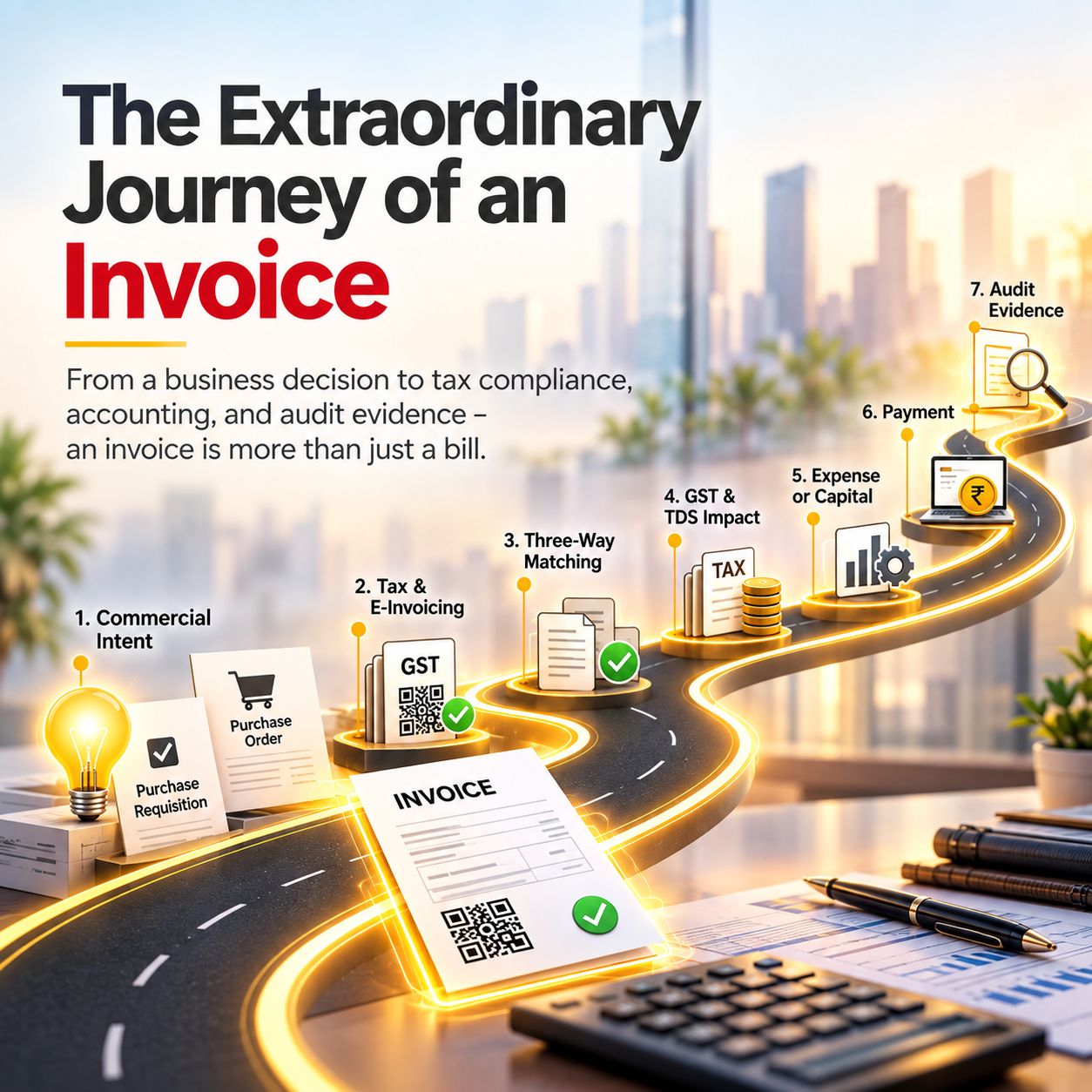
An invoice may look like nothing more than a quiet, single-page PDF resting in an inbox. In reality, it represents an active journey through business strategy, Indian tax compliance, technology workflows, accounting, and internal controls.
Before an invoice becomes an entry in the general ledger, a business owner has made a decision, a manager has approved a purchase, a vendor has delivered goods or services, and a tax framework has attached its rules to the transaction. Long after the invoice is paid, an auditor or tax officer may point to that line item and ask a simple question: “Show me the evidence.”
Here is the financial lifecycle of a single invoice—and why understanding its journey matters to every business owner, CFO, and finance professional.
1. The Life Before the Invoice: Commercial Intent
An invoice does not really begin when a vendor sends a bill. It begins weeks earlier, when a business need arises.
Consider a company hiring a strategy consultant for ₹ 1,00,000. Before any work is performed, the transaction needs a commercial foundation:
- A Purchase Requisition establishes the business need, approval, and budget.
- A Purchase Order (PO) or Engagement Letter defines the scope, deliverables, payment terms, and agreed rates.
When a well-controlled accounting system receives an invoice, it should not come as a surprise. The invoice is the financial outcome of a commercial transaction that has already been initiated, approved, and documented.
2. The Tax and E-Invoicing Gatekeeper
When the vendor issues the invoice, it enters the statutory compliance framework. A GST tax invoice must contain the particulars prescribed under GST law, including relevant GSTINs, invoice number and date, taxable value, tax details, and applicable HSN/SAC information.
For taxpayers covered by India’s e-invoicing provisions, the invoice must also pass through the prescribed e-invoicing system to generate an Invoice Reference Number (IRN) and an associated QR Code.
Under India’s Indirect Tax framework, the tax invoice is a critical document used supporting buyer’s Input Tax Credit (ITC), subject to the applicable statutory conditions. An incorrect GSTIN, tax treatment or Place of Supply can create reconciliation issues and potentially affect the buyer’s ability to claim or retain the eligible credit. So, an invoice is not merely a payment request. It is also a key part of the business’s tax-compliance trail.
3. The Control Check: Three-Way Matching
Once the invoice enters the Accounts Payable workflow, it undergoes one of the most important internal control checks: Three-Way Matching.
Finance asks three basic questions:
1. Did we agree to buy this?
Does the invoice match the Purchase Order or approved commercial terms?
2. Did we actually receive this?
Does it match the Goods Receipt Note, delivery record or service-delivery sign-off?
3. Is the vendor billing what was agreed?
Do the quantities, rates, taxes and other invoice details match the agreed terms?
If a company orders 100 units, receives 80, but is billed for 100, the system should trigger an exception or payment hold. A well-designed control environment does not allow payment to proceed until the transaction and its supporting documentation are aligned.
4. The Tax Conundrum: Dual Identities (GST & TDS) of an Invoice
The ₹ 1,00,000 invoice can carry several financial implications at the same time:
- Commercially: It represents an amount payable to the vendor, subject to applicable taxes and deductions.
- For GST: It may support an eligible Input Tax Credit, provided the relevant GST conditions are satisfied and the transaction is appropriately reflected in the compliance records.
- For Direct Tax: Depending on the nature of the payment and the applicable provisions, it may trigger a Tax Deducted at Source (TDS) obligation, requiring the buyer to deduct and deposit the applicable tax with the government.
The same transaction can therefore create a vendor payable, a potential tax asset, and a statutory tax liability. This is why an invoice cannot be viewed in isolation. Its accounting treatment must be considered alongside its tax implications.
5. Expense vs. Capital: The Judgment Call
Once the commercial and tax treatments are established, the accountant must determine how the expenditure should be recognised: as an expense, as an asset, or a prepaid cost?
For example, if the ₹ 1,00,000 relates to routine software maintenance or support for the current period, it would generally be recognised as an operating expense (OpEx).
If the expenditure relates to acquiring or developing an identifiable software asset that meets the applicable criteria, it may need to be Capitalized (CapEx) and subsequently amortized over its useful life. If the ₹ 1,00,000 represents a three-year subscription paid upfront, the amount may initially be recorded as a Prepaid Expense and recognised over the period to which the service relates.
INVOICE TYPE: ₹ 1,00,000 Software Transaction
- Option A: Routine Maintenance ──> Charge to P&L as OpEx
- Option B: Permanent License ──> Capitalize to Balance Sheet (CapEx)
- Option C: Three-Year Subscription ──> Record as a Prepaid Expense and recognise over the service period
An Optical Character Recognition (OCR) tool or AI engine can extract information from an invoice. But determining the economic substance of the underlying transaction and applying the appropriate accounting treatment still requires professional judgment.
6. The ERP and Working Capital Balancing Act
The invoice is then recorded in the ERP or accounting platform such as Tally, SAP, NetSuite, or Oracle. The ₹ 1,00,000 value is transformed into a structured financial record linked to:
- A Vendor Ledger Account
- A Cost Center or Department
- A General Ledger (GL) Code
- Applicable Payment Terms, such as Net 30 or Net 45
- Relevant Tax Codes and Accounting Classifications
At this stage, the invoice becomes part of the company’s working capital cycle. The procurement team wants to manage cash outflows, the vendor wants timely payment, and applicable statutory requirements including those relating to eligible MSME suppliers, may impose additional considerations around payment timelines. Accounts Payable, therefore, is not simply a record-keeping function. It is also an important part of cash-flow and working-capital management.
7. The Month-End Cut-Off and Reconciliations
At month-end, the finance team must determine whether the invoice has been recognised in the correct accounting period.
For example, if a service was received in March but the invoice arrives in April, the related expense may need to be accrued in March, subject to the applicable accounting framework, so that the financial statements reflect the period in which the service was received.
For example, if a service was received in March but the invoice arrives in April, the related expense may need to be accrued in March, subject to the applicable accounting framework, so that the financial statements reflect the period in which the service was received.
Reconciliations then help validate the numbers recorded in the books:
- Vendor Balance vs. Vendor Statement
- Books of Accounts vs. GST Records/GSTR-2B, where relevant
- TDS Records vs. Form 26AS / AIS, as applicable
- Bank Ledger vs. Bank Statements or Bank Feeds
These reconciliations help ensure that the company’s internal financial records are consistent with relevant external records and supporting documentation.
8. The Ultimate Test: The Auditor’s Knock
Months later, during a statutory audit, tax audit, or other review, our ₹ 1,00,000 invoice may be selected as a sample transaction.
The auditor looks at the ledger entry and asks for the supporting documentation. The complete trail may include:
Purchase Order / Engagement Letter – Goods or Service Receipt Proof – Invoice / E -Invoice (IRN) – Accounting Entry – TDS Records – Bank Payment Proof
The objective is simple: can the business demonstrate that the transaction was genuine, properly authorised, correctly accounted for and appropriately supported? If every link in the chain holds, the transaction stands on solid ground. If a critical link is missing or inconsistent, the business may face questions relating to tax treatment, expense deductibility, ITC, internal controls or financial reporting.
The Bigger Picture
An invoice starts as a request for payment. By the time it reaches the financial statements, it has travelled through contracts, approvals, tax rules, accounting policies, technology systems and internal controls.
Technology can make that journey faster. It can extract invoice data, match documents, identify exceptions and even automate accounting entries.
But speed is not the same as understanding.
The real value of accounting lies in asking whether the transaction is genuine, whether it belongs in the correct period, whether it has been classified and recorded correctly, whether its implications have been addressed, and whether the numbers tell the same story as the underlying business activity.
In that sense, every invoice is more than a document.
It is a small piece of evidence from which the financial story of a business is built.