
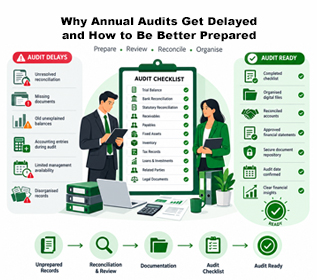
For most businesses, the annual audit is expected to begin once the financial year is closed and the books are finalised. In practice, however, an audit rarely starts with just a Trial Balance.
An efficient audit requires supporting schedules, reconciliations, confirmations, explanations for significant balances and access to relevant documents. When these are not available at the beginning of the audit, the process can turn into repeated queries, revised workings and multiple follow-ups.
This is one of the key reasons why an audit that could otherwise be completed within a defined timeline often gets extended. The quality and completeness of information available at the start can significantly influence how smoothly the audit progresses.
What Should Be Ready Before the Audit Begins?
The exact requirements depend on the size and nature of the business, but certain areas are common to almost every audit.
1. Final Trial Balance and General Ledger
The Trial Balance should be genuinely final, complete and reviewed before it is shared with the auditor. Management should ideally ensure that:
- All transactions for the year have been recorded.
- Opening balances agree with the previous year’s audited financial statements.
- Bank, customer, vendor and inter-company balances have been reviewed.
- Suspense and miscellaneous balances are cleared wherever possible.
- Significant or unusual movements have been identified and appropriately explained.
A Trial Balance may be technically “final” but still contain several unresolved balances. This can result in the audit team spending considerable time identifying and clarifying issues that could have been addressed before the audit commenced.
2. Key Reconciliations
Reconciliations are among the most important aspects of audit readiness. They help ensure that balances recorded in the books are accurate, complete and supported by underlying records.
These may include:
- Bank reconciliations.
- Customer and vendor reconciliations.
- Inter-company and related-party reconciliations.
- GST reconciliation with the books.
- TDS/TCS reconciliation.
- Reconciliation of tax credits with Form 26AS, AIS and TIS, wherever relevant.
Differences identified during these reconciliations should ideally be investigated and resolved before the audit begins. Otherwise, the audit can become a process of identifying and resolving accounting differences rather than testing and validating the final numbers.
3. Receivables and Payables Review
The auditor would generally require ageing schedules and details of significant, overdue or long-outstanding balances.
Management should review:
- Long-outstanding receivables.
- Old vendor balances.
- Advances to customers and vendors.
- Balances under dispute.
- Related-party balances.
- Provision or impairment requirements, where applicable.
Where audit confirmations are required, the relevant contact details and supporting information should also be readily available.
Old balances without clear explanations or supporting documentation are a common source of audit queries and can lead to delays in completing the audit.
4. Fixed Assets and Inventory
For fixed assets, the Fixed Asset Register should be updated and reconciled with the books. Details of significant additions, disposals, depreciation and asset locations should be available, along with the relevant supporting invoices and documents.
For businesses carrying inventory, the audit team may require the year-end stock statement, inventory valuation workings, physical verification records and reconciliation of physical quantities with the books.
Slow-moving, obsolete or damaged inventory should be identified and evaluated for any necessary provision or adjustment. Significant additions or disposals of fixed assets should be supported by appropriate documentation and properly recorded in the books.
5. Statutory Dues and Tax Matters
The audit team would generally need information relating to GST, TDS/TCS, income-tax and other applicable statutory dues.
This should include, as relevant:
- Returns filed.
- Tax payments made.
- Reconciliations with the books.
- Outstanding demands or notices.
- Advance tax payments and tax provisions.
- Ongoing tax disputes or significant positions taken by the company.
Tax and statutory reconciliations should ideally be completed before the audit queries. This helps the audit team verify the balances more efficiently and allows potential discrepancies to be addressed in advance.
6. Loans, Investments and Related Party Transactions
For borrowings and investments, relevant statements, confirmations, interest workings, repayment schedules and valuation details should be readily available for review.
Similarly, related-party transactions should be identified, documented and reconciled before the audit begins. This includes transactions and balances involving group companies, directors, key management personnel and other applicable related parties.
A clear understanding of the group’s structure, along with the complete details of related-party transactions and balances, can help avoid repeated information requests facilitate a smoother audit process.
7. Legal Matters and Commitments
Management should proactively inform the auditor about significant litigation, tax proceedings, claims, guarantees, commitments and other potential liabilities. Management should proactively inform the auditor about significant litigation, tax proceedings, claims, guarantees, commitments and other potential liabilities.
These matters may have accounting and disclosure implications, and the auditor may require supporting documents, legal confirmations or management representations.
These matters may have accounting and disclosure implications, and the auditor may require supporting documents, legal confirmations or management representations.
Common Reasons for Audit Delays:
- Reconciliations are prepared only after queries are raised.
Bank, GST, TDS and inter-company reconciliations should ideally be completed before the audit begins.
- Supporting documents are difficult to locate.
Invoices, agreements, confirmations and other records may exist but are not organised or readily accessible when required.
- Old balances have no clear explanation.
Long-standing receivables, payables, advances and deposits often require significant management input to understand and resolve.
- Accounting entries continue during the audit.
If significant adjustments are passed after audit testing has started, previously completed procedures may need to be revisited.
- Management availability becomes a bottleneck.
Certain audit matters require inputs from promoters, CFOs, legal teams or other senior personnel and cannot always be resolved by the accounts team alone.
A simple Audit Readiness Checklist
Before the auditor starts, management should ideally be able to answer “Yes” to the following:
| Area | Key Question |
| Trial Balance | Is it final and reviewed? |
| Bank | Are all bank reconciliations completed? |
| Receivables/Payables | Have ageing and old balances been reviewed? |
| Fixed Assets | Is the Fixed Asset Register updated and reconciled? |
| Inventory | Is physical stock reconciled with the books? |
| GST/TDS | Are statutory reconciliations completed? |
| Tax | Are tax payments, provisions and outstanding matters reviewed? |
| Loans/Investments | Are statements and supporting workings available? |
| Related Parties | Are transactions and balances identified and reconciled? |
| Legal Matters | Are litigation, claims and commitments updated? |
| Documents | Are significant transactions supported by proper documentation? |
| Management | Are responsible persons available to resolve queries? |
Audit Readiness Is a Shared Responsibility
An audit will naturally involve questions. That is an essential part of the audit process and cannot be completely eliminated.
The objective is to ensure that the basic information, reconciliations and supporting documentation are ready before the audit begins. This allows the auditor to focus on areas requiring professional judgement, risk assessment and detailed testing rather than spending excessive time obtaining basic information.
For management, early preparation also has another benefit: accounting, tax and compliance issues can be identified sooner, when they are generally easier to understand and resolve.
A timely audit is therefore not solely the responsibility of the auditor or the finance team. It is a shared process that requires preparation, coordination and timely inputs from all concerned.
The goal should not simply be to finish the audit quickly. The goal should be to start with the right information, resolve issues systematically and arrive at financial statements that management can confidently rely upon.
When everyone is audit-ready from the outset, the process becomes more organised, efficient and focused on what truly matters, providing greater confidence in the financial statements.